
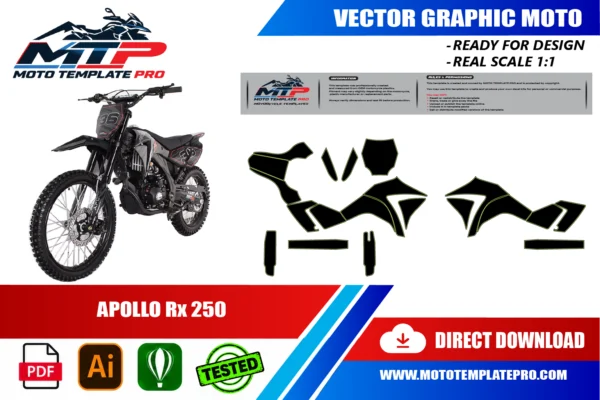

This Apollo RX 250 vector template reproduces the Apollo RX 250 at real scale (1:1) as an editable vector file.
Table of Contents
Apollo RX 250 Vector Template: Overview
Use this Apollo RX 250 vector template as an accurate base for decal kits, vinyl wraps, custom liveries and other graphics on the Apollo RX 250. It is made for graphic designers, wrap installers and sticker manufacturers.
The Apollo RX 250 template is built for a full-size, air-cooled 250 cc off-road bike that is sold in several markets, mostly through importers and powersports dealers. Our outlines follow its body panels at real size, so a designer, wrap installer or sticker maker can start from accurate shapes instead of guessing curves from a catalogue photo.
Each file contains editable vector contours of the body panels at 1:1 scale, in AI, PDF and CorelDRAW formats, with layers grouped by part. It is a starting point for your own design, never a finished artwork, a decal kit or a physical item, and we are an independent design resource with no link to any bike maker.
The Apollo RX 250 is the kind of bike that lives on farm tracks, trail loops and weekend practice days, where plastics are scuffed by boots, branches and the odd tip-over. Owners often want a fresher look at a sensible cost, and a precise outline lets you plan that makeover on screen before you buy a single metre of film.
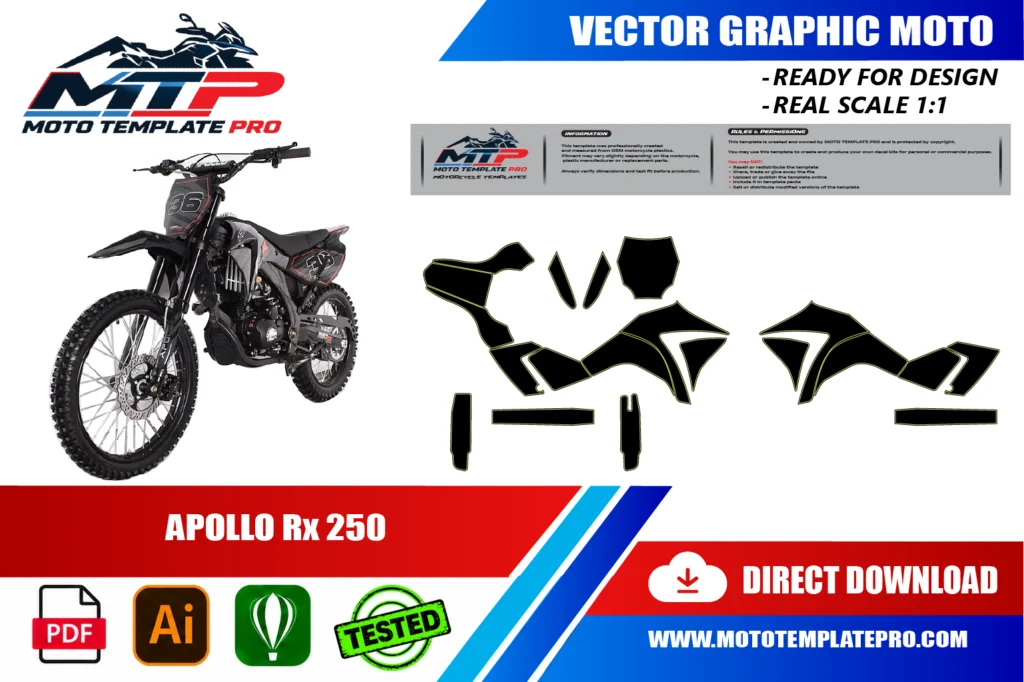
The template is provided as an editable vector file, compatible with Adobe Illustrator, PDF and CorelDRAW. It is a starting point for your own design work rather than a finished, ready-to-print graphic: a precise outline of the panels that you can use to position decals, plan a wrap layout or prepare a sticker kit at the correct scale. For background on why vector files are the standard for wrap and decal production, see the Adobe comparison of raster and vector formats.
What the Apollo RX 250 is, and how it is sold
According to the sources we checked, Apollo is a Chinese maker of powersports vehicles, with dirt bikes ranging from about 110 cc up to 250 cc, and the Apollo RX 250 is the adult-size bike at the top of that range. It is listed by several US-focused retailers, and the same machine appears under different codes in different shops. We saw it described as DB-36, RX36C and RFZ 250, and the title of a forum thread in a Chinese-bike section reads Apollo 2019 RX 250, which suggests the bike was on sale around 2019. We could not confirm a launch year or a list of changes between model years.
This matters because a retailer may show a different name, a different colour set or a street-legal variant for what looks like the same bike. The name Apollo RX 250 is the common denominator, but the Apollo RX 250 is sold under various names depending on the market, so compare your own bike with the outline before you order.
We therefore describe the bike in broad, hedged terms. Where one retailer gives a number and another gives a different one, we say so instead of choosing the figure that looks best.
One more caution on history: forum titles and retailer pages are not manufacturer documents. When a listing shows a model year, treat it as the seller’s description of the stock they received, which may not match the year of your own Apollo RX 250. Your frame plate or your purchase invoice is the better guide.
Engine and running gear of the Apollo RX 250
Retailers describe a single-cylinder, four-stroke, air-cooled 250 cc engine with a five-speed manual gearbox, a clutch and chain drive, with a kick starter and, on some listings, electric start. Power figures differ: one page quotes 12.5 kW at 7,000 rpm, another about 11.5 kW (15.6 hp) with 17.5 N·m of torque and a 67 x 65 mm bore and stroke. Because the numbers disagree, treat them as approximate and as varying by market and version.
The running gear is large. Listings mention a 21-inch front and an 18-inch rear wheel (80/100-21 and 110/90-18 tyres on one page), hydraulic disc brakes at both ends and a tall seat quoted between about 36.6 and 37 inches, roughly 93 to 94 cm. One page gives a net weight near 260 lb, another an 8-litre fuel tank and ground clearance around 36 cm. We did not verify these figures against a manufacturer document.
For a designer the consequence is simple. The Apollo RX 250 has the long, upright stance of a full-size motocross or trail bike, so its plastics are tall and narrow, and a graphic has to flow along them from the front fender to the tail.
The five-speed gearbox and the larger wheels also mean this bike is ridden harder than a youth machine. Riders lean over the front fender in tight turns and grip the shrouds with their knees, so those two zones take the most wear, and a wrap there needs a tough overlaminate and well-sealed edges.
Body panels of the Apollo RX 250, named one by one
Think of the bike in zones. At the front, the number plate sits above the headstock and the front fender covers the 21-inch wheel. The shrouds wrap the sides of the tank area and guide air towards the engine, the side panels cover the flanks around the airbox, and the rear fender and tail section form one long, narrow surface at the back. The seat has its own textured cover, which should not receive a decal.
- Front number plate and front fender
- Shrouds, left and right
- Side panels and airbox area
- Rear fender and tail section
We did not verify whether the fuel tank is plastic or steel on every version, nor how the shrouds are split, so read the product description for the parts that are actually drawn. Our files give vector outlines at real 1:1 scale in AI, PDF and CorelDRAW, with layers grouped by part, so you can hide the front while you work on the tail.
Before opening the file, photograph each panel straight on with a ruler beside it. Compare the picture with the outline and note where holes, cut-outs and fixings sit on your Apollo RX 250.
Remember that some panels come off more often than others. The side panels and the airbox cover are removed for filter cleaning, so artwork that crosses their joints tears at every service. Plan a clean break at the seam, and check on the bike where the retaining clips sit before you draw a continuous line.
Livery ideas for the Apollo RX 250: trail, track and farm
A tall bike rewards long, rising lines. A stripe that starts on the front fender, climbs over the shroud and reaches the tail makes the Apollo RX 250 look longer and lower, which is the opposite of how a tall, narrow bike usually appears. Large blocks of colour survive dust and mud far better than thin lines and small text.
Directions to try
- Retro trail: cream, red and black bands with a simple circular number plate.
- Night ride: dark graphite panels with one bright accent line on the shrouds.
- Field and forest: matt olive and sand, with a small route-map texture on the side panels.
- Team colours: one strong colour on the shrouds, the same tone repeated on the fender and the tail.
One retailer lists red, black, blue, green and orange for the Apollo RX 250, but we did not verify the colours for other markets or years, so judge your design against the plastics you actually have. Use your own names and graphics rather than another brand’s logos, since we are not connected to any bike maker.
Whatever direction you choose, keep a clear zone on the front plate for the rider’s number or a personal mark, and keep dense detail off the rear fender, which collects most of the mud. Test the colours in daylight with a small sample taped to the real panel, because metallic and fluorescent films look different outdoors.
From outline to cut file for the Apollo RX 250
Open the file and rename the layers for your job. Name left and right sides explicitly, and lock each finished panel so that a stray click cannot move an outline. Work on one part at a time, then switch every layer on and judge the whole bike from nose to tail.
Extend the artwork about 3 to 5 mm beyond each contour for bleed, and keep text, numbers and logos away from edges, screws and fasteners. On the Apollo RX 250, the shrouds and the side panels meet at visible seams, so a continuous stripe should have intentional breaks rather than perfect alignment.
Print a paper copy at 100 percent, never fit to page, and tape it to the bike. If it does not match, measure the part and adjust the outline before the cutter starts. Agree the colour workflow with your print partner: CMYK with the right profile, text converted to outlines and a separate colour for the cut path. Export a flattened proof for the customer and keep a layered master.
For a customer who wants to see the idea first, render the design flat on the outline and send a side-view proof. It is much cheaper to change a stripe on screen than on a cut sheet, and it gives the customer a clear moment to approve the result before any vinyl leaves the roll.
Vinyl, heat and wear on the Apollo RX 250
An air-cooled engine runs hot and the plastics near the exhaust and the cylinder see real heat. Keep film away from those zones, and ask your supplier about heat resistance for any panel close to the exhaust. Choose quality cast vinyl for the curved parts and a UV-resistant overlaminate for everything exposed to sun, and follow the manufacturer’s datasheet.
Clean the plastic with isopropyl alcohol and avoid silicone products. Position the piece with tape hinges and squeegee from the centre outwards, using gentle heat only where the film must stretch. Test adhesion on a hidden spot first, because plastics on imported bikes can have a slightly different finish from one batch to the next.
Wrap edges around the rim when the shape allows, and let the adhesive bond for a day before the first ride. Avoid pressure washers close to edges, and check them again after the first muddy session, because a small lifted corner is easy to press down early.
Finally, set realistic expectations about durability. Even a well-applied wrap on a bike that is washed hard, ridden through brush and knocked by boots will need attention after a season. Keep a spare printed sheet of the busiest panels, such as the shrouds, so you can replace a damaged piece without redoing the whole bike.
Naming, variants and fit: measure before ordering for the Apollo RX 250
The most honest advice is to measure first. Retailers sell several variants, including a street-legal dual-sport version with lights, a 19-inch front wheel and mirrors, and the plastics of that version may differ from the standard off-road bike. We cannot promise that the outlines fit every bike sold under the Apollo RX 250 name.
Replacement plastics are cheap and common on this kind of bike, and they are not always exact copies. Check the shroud shape, the fender length and the position of the fixings, and compare them with the outline using a measurement, not only a photograph.
If you hesitate, send us photos of the front plate, the shrouds, the side panels and the tail, taken straight on with a ruler in the frame. The outlines are a design base for the Apollo RX 250, with colours, graphics and equipment that vary by market, so measure first and order afterwards.
Remember that the template is a drawing base, not a promise of a fit, a finished design or a physical part. The more carefully you compare the outline with your bike, the fewer surprises you will meet at the cutter.
How This Template Is Built
This Apollo RX 250 vector template is rebuilt as a fully editable vector outline from the real panel proportions of the Apollo RX 250, rather than a rough tracing or a stretched photo. Working at true 1:1 scale means printers and installers can output panels straight from the file without rescaling, which keeps stripes, sponsor logos and pinstripes aligned exactly where they were designed.
Because the panel outlines are kept as separate, editable shapes, you can turn individual sections on or off while you design and export only the panels you actually need for production. On a vehicle of this kind (motocross or off-road bike), the typical panel groups include the front fender, radiator shrouds, side number plates, airbox cover and rear fender. Before printing, always measure a panel on the real vehicle against the file, since small production differences can happen and a quick check avoids a costly reprint.
What You Can Use This Template For
- Motocross decal and graphics kits
- Race team and sponsor graphics
- Number plate and rider name designs
- Full or partial vinyl wrap layouts
- Custom race liveries
This Apollo RX 250 vector template suits race teams and riders preparing a new graphics kit, wrap shops quoting jobs sight-unseen, and sticker manufacturers who need a reliable base file instead of starting from photographs. Because the panel outlines are separated rather than merged into one flattened shape, you can isolate a single panel and export only what you need, which saves time when a project only touches part of the vehicle.
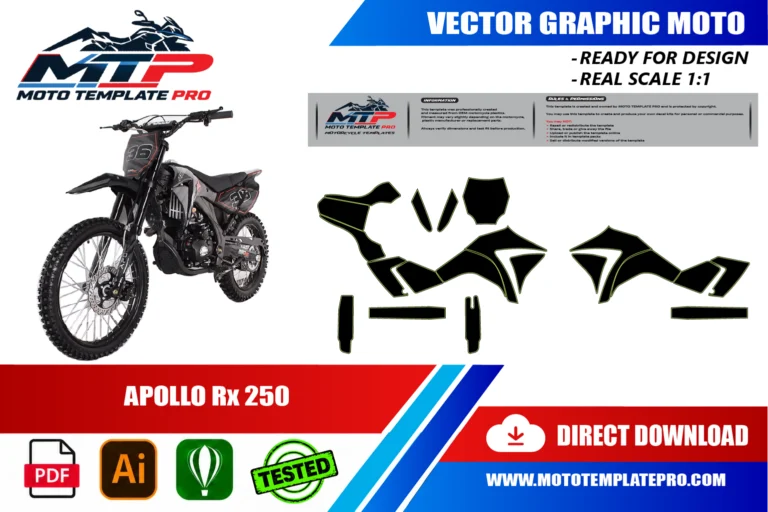
Files Included and How to Use Them
After purchase you get an instant digital download of the Apollo RX 250 vector template in three formats. A typical workflow takes only a few steps:
- Download the file from your account or order email right after payment.
- Open the AI, PDF or CorelDRAW version in your vector software.
- Hide the panels you do not need and place your graphics, logos and colors on the rest.
- Print one test panel at 1:1 and check it against the real vehicle.
- Export the final artwork for your printer or cutter.
Printing, Scale and File Notes
Before you print this Apollo RX 250 vector template, remember that it is built at real 1:1 scale, so the safest workflow is to print a single test panel first and lay it against the actual Apollo RX 250 before committing to a full print run. A short test print is cheap insurance against a wasted roll of vinyl, especially around curved sections.
The vector layers are grouped by panel, which keeps the file manageable if you only need a subset of the panels, useful for a partial wrap, a single panel graphic or a small decal pack. If you run into a fitment question that is not covered here, reach out before you print. We would rather answer a quick question in advance than have you reprint a panel.
Also in our catalog: AM Thunder 70cc 110cc Vector Template, Arctic Leopard XE Pro R Vector Template, Beta Enduro RR X-Pro 2025-2026 Vector Template, Beta RX 300 RR RR-S 2023-2024 Vector Template, Beta Xtrainer 2023-2026 Vector Template, Sherco SE SEF 2017-2022 Vector Template.
Browse all Apollo vector templates.
Moto Template Pro is an independent design resource and is not affiliated with, endorsed by, or sponsored by Apollo or any manufacturer.
Which model years does this Apollo RX 250 vector template cover?
This template is built specifically for the Apollo RX 250.
Which panel is the best first project on an Apollo RX 250?
The side panels and shrouds are a friendly start: visible, fairly smooth and with few fasteners to avoid. Practise your method there, then move to the front fender and the tail, which have stronger curves.
Is the Apollo RX 250 the same bike as the DB-36 or the RX36C?
We cannot say. They appear to be closely related and are sold by the same type of retailers, but we did not verify that every panel is identical. Compare the outline with your real plastics before printing or cutting.
Which files come with the Apollo RX 250 template?
You receive vector outlines in AI, PDF and CorelDRAW at real 1:1 scale, with layers grouped by part. It is a design base, not a finished artwork and not a decal kit, and it does not include a physical item.
Can I wrap the hot areas of an Apollo RX 250?
Be careful. Keep film away from the exhaust and the cylinder area, ask your supplier about heat resistance, and use a UV-resistant overlaminate on the parts exposed to sun.
Does the Apollo RX 250 come in a fixed set of colours?
Not necessarily. One retailer lists red, black, blue, green and orange, but colours and graphics vary by market and year, so look at your own plastics first.
Is this template compatible with other models?
No. Each model and generation has different bodywork, so this template is specific to this platform and differs from every other template in our catalog.
What file formats are included?
The template is provided in Adobe Illustrator, PDF and CorelDRAW, all as editable vector layers rather than a flattened image.
How is the file delivered?
As an instant digital download available immediately after purchase, with no physical items shipped and no waiting on a production schedule.
Is this an official Apollo product?
No. Moto Template Pro is an independent business, not affiliated with Apollo.
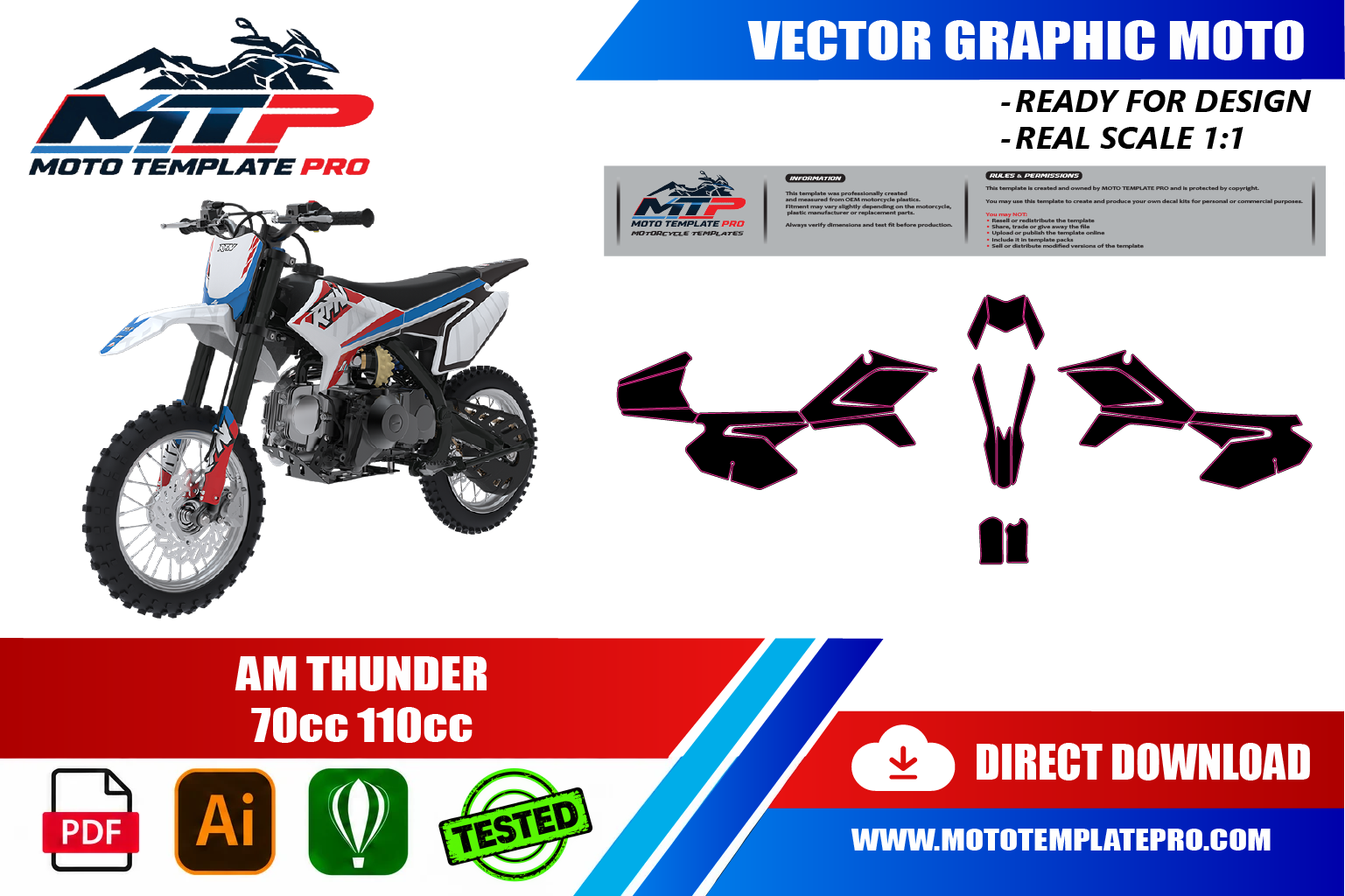
AM Thunder 70cc 110cc Vector Template

Stark Varg EX 2024-2025 Vector Template
SurRon Light Bee Vector Template
TM Racing MX 450 300 250 2015-2021 Vector Template


Reviews
There are no reviews yet.