



This Yamaha YZF R1 2009-2014 vector template reproduces the Yamaha YZF R1 2009-2014 at real scale (1:1) as an editable vector file.
Table of Contents
Yamaha YZF R1 2009-2014 Vector Template: Overview
Use this Yamaha YZF R1 2009-2014 vector template as an accurate base for decal kits, vinyl wraps, custom liveries and other graphics on the Yamaha YZF R1 2009-2014. It is made for graphic designers, wrap installers and sticker manufacturers.
The Yamaha YZF R1 2009-2014 template is a vector design base for the crossplane-engined liter-class sportbike that Yamaha sold for six seasons. Our files trace the body panels of the Yamaha YZF R1 2009-2014 at real 1:1 scale, so designers, vinyl-wrap installers and sticker makers can plan graphics on exact outlines rather than working from photographs and guesswork.
Each download contains editable vector contours in AI, PDF and CorelDRAW formats, with layers grouped by panel. It is a starting point for your own artwork: not a finished design, not a ready-made decal kit and not a physical part. Yamaha is a trademark of its owner; we are an independent design resource and have no affiliation with Yamaha.
Six years is a long time for one model. The bike received a mid-life update in 2012, and the sources we read disagree on how much of the body changed. That uncertainty is the reason this page spends so much time on checking: on the Yamaha YZF R1 2009-2014, a paper test and a careful comparison with your own bike are the real starting point of any graphics project.

The template is provided as an editable vector file, compatible with Adobe Illustrator, PDF and CorelDRAW. It is a starting point for your own design work rather than a finished, ready-to-print graphic: a precise outline of the panels that you can use to position decals, plan a wrap layout or prepare a sticker kit at the correct scale. For background on why vector files are the standard for wrap and decal production, see the Adobe comparison of raster and vector formats.
Where the Yamaha YZF R1 2009-2014 comes from
When the 2009 model arrived, Yamaha described its new engine as the first crossplane-crankshaft unit in a production sportbike, according to the sources we checked, and the bike was presented as a fresh start rather than an update. It kept the 998 cc displacement of the previous model but changed the firing order, the character and, with them, much of the front-end styling. Reviewers of the time praised the strong midrange and the unusual sound, but for a graphic designer the lasting legacy is the shape of the plastics.
The best-documented change inside the range came in 2012, when the sources mention a traction control system, new end cans, a MotoGP-style top yoke, new footrests and a limited-edition red and white anniversary scheme. One source calls the nose redesigned, another says only that the fairing and lights were tweaked. For 2013 and 2014 we found no specific changes, which does not prove there were none.
What this means in practice: the range splits into an early group (2009-2011) and a later group (2012-2014), and the plastics may not be interchangeable between them. Note the year of manufacture and, if possible, which group your bike belongs to, then keep that note with the project files of your Yamaha YZF R1 2009-2014.
What the name Yamaha YZF R1 2009-2014 means in our catalog
The listing is called Yamaha YZF R1 2009-2014, and we keep that name exactly as it appears in our catalog. The first part is the model name used by Yamaha; the six years describe a catalog range that groups all the bikes built on this generation of the platform. It is not a guarantee that every panel is identical from 2009 to 2014.
Because the range is wide, we treat it with extra caution. Where a source gives a clear year for a change, such as 2012, we mention it. Where a source is vague, we say so. Where nobody seems to have written anything down, as for 2013 and 2014, we do not pretend to know. That honest position is better for you than a confident claim that turns out to be wrong after the film is cut.
The product is a digital file. Nothing is shipped, and nothing is printed or cut for you. If your bike is a limited edition, a track conversion or wears aftermarket bodywork, tell us the year and send photographs of the nose, tank cover and tail before you buy, and we will tell you what we can about the Yamaha YZF R1 2009-2014 outlines.
Engine and chassis facts behind the Yamaha YZF R1 2009-2014
Reports describe a 998 cc liquid-cooled inline-four with 16 valves and a crossplane crankshaft, fed by Yamaha’s ride-by-wire throttle, with three selectable throttle maps. Power figures vary: one buyer’s guide gives about 180 bhp, while another reference lists 191 hp for 2009, and the sources do not agree on whether ram air is included. Weight is also reported two ways, around 206 kg wet in one place and 177 kg dry in another. Treat all of these numbers as claims.
The chassis is an aluminium Deltabox frame with a magnesium rear subframe, and inverted forks with split damping are mentioned. One detail matters to a designer: the sources say there was no ABS on these bikes, and traction control only arrived in 2012. If your bike has no traction control switch on the handlebar, it is probably a 2009-2011 machine; verify this against the registration papers.
The engine’s uneven firing gives the bike a distinctive sound, but what matters for graphics is the packaging: a big airbox, ram-air ducts beside the headlights and a fairly tall tank. These shape the nose of the Yamaha YZF R1 2009-2014 more than any other factor.
Heat is concentrated near the lower fairing and the rear end cans. Keep fine print and thin lines away from those zones, and put large, simple shapes there instead.
Body panels of the Yamaha YZF R1 2009-2014 and how to read them
The 2009 front end is described as having projector-only headlamps with ram-air intakes beside them, a look quite different from the cat-eyed shape of the 2007-2008 bike. The tank cover is tall and wide, the side fairings carry visible vents, and the tail ends in a compact unit above the end cans.
- Upper fairing and nose, with headlight openings and ram-air intakes
- Left and right side fairings, with vents
- Windscreen area and fairing mounts
- Tank cover and tank sides
- Seat unit and tail section
- Lower belly fairing
- Front mudguard
As elsewhere in this catalog, the list is a glossary of typical parts, not a promise about what is drawn in every year. Our files give you vector outlines at real 1:1 scale in AI, PDF and CorelDRAW, grouped in layers by panel, so you can switch off the tank and focus on the side fairing, or pull out a single panel for a printed test. We did not verify how each panel is divided in every year, so read the product description to see which pieces are included.
Compare before and after 2012 carefully: if the nose on your bike differs from the template, stop and ask. Photograph each part of your Yamaha YZF R1 2009-2014 with a ruler in view, because these pictures are the best evidence when file and bike disagree.
Livery and graphics ideas for the Yamaha YZF R1 2009-2014
The bike has a lean, muscular shape with a lot of surface on the tank cover and the upper fairing, which makes it a good canvas for large graphics. Start from your own colours: the sources mention a red and white anniversary scheme in 2012, but we did not verify the colours sold in each country or each year.
- Anniversary tribute: red and white blocks on the nose and tank cover, with a clean division along the main crease.
- Sound-wave motif: thin parallel lines that start at the engine and fan out across the side fairings, a nod to the engine’s unusual firing.
- Dark and quiet: satin black with a faint gloss pattern on the tank, and small coloured accents around the ducts.
- Track-day numbers: a white number panel on the nose and tail, plus bold side numbers.
The ram-air ducts and the headlight openings are holes; draw them as holes and keep colour edges a few millimetres away. Place the strongest graphic element on the tank cover and upper fairing, where the surface is large and less exposed to engine heat.
Think about the tank cover first. It is the largest uninterrupted surface on this bike, so it deserves the main idea; the side fairings should support it with a quieter version of the same theme, so that the bike reads as one design from every angle.
A long stripe from the nose to the tail crosses at least four parts. Draw it as continuous on screen, then split it at each join and add overlap marks, so the installer can align the pieces without guessing.
Measuring, test-fitting and vinyl choices for the Yamaha YZF R1 2009-2014
Extend artwork 3 to 5 mm beyond each contour for bleed, and keep text, numbers and logos clear of edges, screws and vents. Print on paper at 100 percent, never fit to page, and tape the sheets onto the bike. Walk around it and look from several angles; if the paper does not lie as the outline did on screen, measure again before cutting. Photograph the paper on the bike and compare the photo with the screen, since a picture often reveals a small mismatch that the eye misses.
For the Yamaha YZF R1 2009-2014, spend extra time on the nose and the lower fairing: both have compound curves and cut-outs. A large flat sheet will wrinkle there, so plan relief cuts or split the graphic into two pieces and hide the join along a crease.
Use quality cast vinyl on curved panels and calendered film on flat or gently curved ones. Follow the film maker’s datasheet and protect the print with a UV-resistant overlaminate. Satin finishes hide small marks better than gloss.
Clean with isopropyl alcohol and avoid silicone sprays. Hinge each piece with masking tape, squeegee from the centre outward, and apply gentle heat only where the film must stretch. Keep film off lamp lenses, sensors and the heat zone near the end cans, and test adhesion on a hidden spot first.
File formats and compatibility cautions for the Yamaha YZF R1 2009-2014
You receive AI, PDF and CorelDRAW files made of vector paths, which scale without loss of sharpness. Most vector editors that open PDF can read the outlines, and Illustrator and CorelDRAW users may prefer their native files. We cannot test every program, so open the file and draw a rectangle of known size to check the scale before you design.
Compatibility can vary with the year, the market and the parts fitted. This range spans six seasons and a mid-life update, aftermarket fairings are common on a popular sportbike, and many examples have been repaired. The outlines of the Yamaha YZF R1 2009-2014 are a base, not a promise of a perfect fit for every individual bike.
Keep the result of the scale test in your project notes and work on a copy of the original file, so you can always return to the clean outlines. Anyone who takes over the job can then verify the Yamaha YZF R1 2009-2014 file in a few seconds.
How This Template Is Built
This Yamaha YZF R1 2009-2014 vector template is rebuilt as a fully editable vector outline from the real panel proportions of the Yamaha YZF R1 2009-2014, rather than a rough tracing or a stretched photo. Working at true 1:1 scale means printers and installers can output panels straight from the file without rescaling, which keeps stripes, sponsor logos and pinstripes aligned exactly where they were designed.
Because the panel outlines are kept as separate, editable shapes, you can turn individual sections on or off while you design and export only the panels you actually need for production. On a vehicle of this kind (sport bike), the typical panel groups include the tank cover, fairings, side panels and tail section. Before printing, always measure a panel on the real vehicle against the file, since small production differences can happen and a quick check avoids a costly reprint.
What You Can Use This Template For
- Full or partial vinyl wrap layouts
- Decal and sticker kits
- Custom liveries
- Tank and fairing graphics
- Sponsor logo and branding placement
This Yamaha YZF R1 2009-2014 vector template suits riders planning a full wrap or a partial decal kit, wrap shops quoting jobs sight-unseen, and sticker manufacturers who need a reliable base file instead of starting from photographs. Because the panel outlines are separated rather than merged into one flattened shape, you can isolate a single panel and export only what you need, which saves time when a project only touches part of the vehicle.

Files Included and How to Use Them
After purchase you get an instant digital download of the Yamaha YZF R1 2009-2014 vector template in three formats. A typical workflow takes only a few steps:
- Download the file from your account or order email right after payment.
- Open the AI, PDF or CorelDRAW version in your vector software.
- Hide the panels you do not need and place your graphics, logos and colors on the rest.
- Print one test panel at 1:1 and check it against the real vehicle.
- Export the final artwork for your printer or cutter.
Printing, Scale and File Notes
Before you print this Yamaha YZF R1 2009-2014 vector template, remember that it is built at real 1:1 scale, so the safest workflow is to print a single test panel first and lay it against the actual Yamaha YZF R1 2009-2014 before committing to a full print run. A short test print is cheap insurance against a wasted roll of vinyl, especially around curved sections.
The vector layers are grouped by panel, which keeps the file manageable if you only need a subset of the panels, useful for a partial wrap, a single panel graphic or a small decal pack. If you run into a fitment question that is not covered here, reach out before you print. We would rather answer a quick question in advance than have you reprint a panel.

Also in our catalog: Yamaha YZF R1 2004-2006 Vector Template, Yamaha YZF R15 M V4 Vector Template, Yamaha YZF R15 V3 2019-2021 Vector Template, Yamaha YZF R1 2015-2019 Vector Template, Yamaha YZF R1 2020-2024 Vector Template, Yamaha YZF R7 2021-2024 Vector Template.
Browse all Yamaha vector templates.
Moto Template Pro is an independent design resource and is not affiliated with, endorsed by, or sponsored by Yamaha or any manufacturer.
Which model years does this Yamaha YZF R1 2009-2014 vector template cover?
This template is built specifically for the Yamaha YZF R1 2009-2014.
Is the Yamaha YZF R1 2009-2014 template an official Yamaha product?
No. It is made by an independent design resource and has no affiliation with Yamaha, which is a trademark of its owner. It is a vector design base with real-scale outlines, not a finished artwork, a decal kit or a physical part.
Which file formats are supplied with the Yamaha YZF R1 2009-2014 template?
AI, PDF and CorelDRAW. Each one contains vector outlines at real 1:1 scale with layers grouped by panel, so you can edit shapes, add your own artwork and export a file for your cutter.
Does one Yamaha YZF R1 2009-2014 template suit every year from 2009 to 2014?
We cannot promise it. The range covers six seasons and a 2012 update, and details vary by year and market. Compare a paper print at 100 percent with your real panels before you cut any vinyl. The early 2009-2011 bikes and the later 2012-2014 bikes are the two groups to check.
Can the Yamaha YZF R1 2009-2014 file go straight to a print shop?
It is a base for your own design, not a finished artwork. Add your graphics inside the outlines, allow 3 to 5 mm of bleed, keep text away from edges and vents, and run a paper test before the final print.
Do the Yamaha YZF R1 2009-2014 outlines cover the 2012 update?
The sources we checked say the 2012 bike gained traction control, new end cans and a modified fairing, but they disagree on how much the nose changed. Read the product description to see which pieces are drawn, then compare the outline with your own nose and fairing before ordering.
Is this template compatible with other models?
No. Each model and generation has different bodywork, so this template is specific to this platform and differs from every other template in our catalog.
What file formats are included?
The template is provided in Adobe Illustrator, PDF and CorelDRAW, all as editable vector layers rather than a flattened image.
How is the file delivered?
As an instant digital download available immediately after purchase, with no physical items shipped and no waiting on a production schedule.
Is this an official Yamaha product?
No. Moto Template Pro is an independent business, not affiliated with Yamaha.
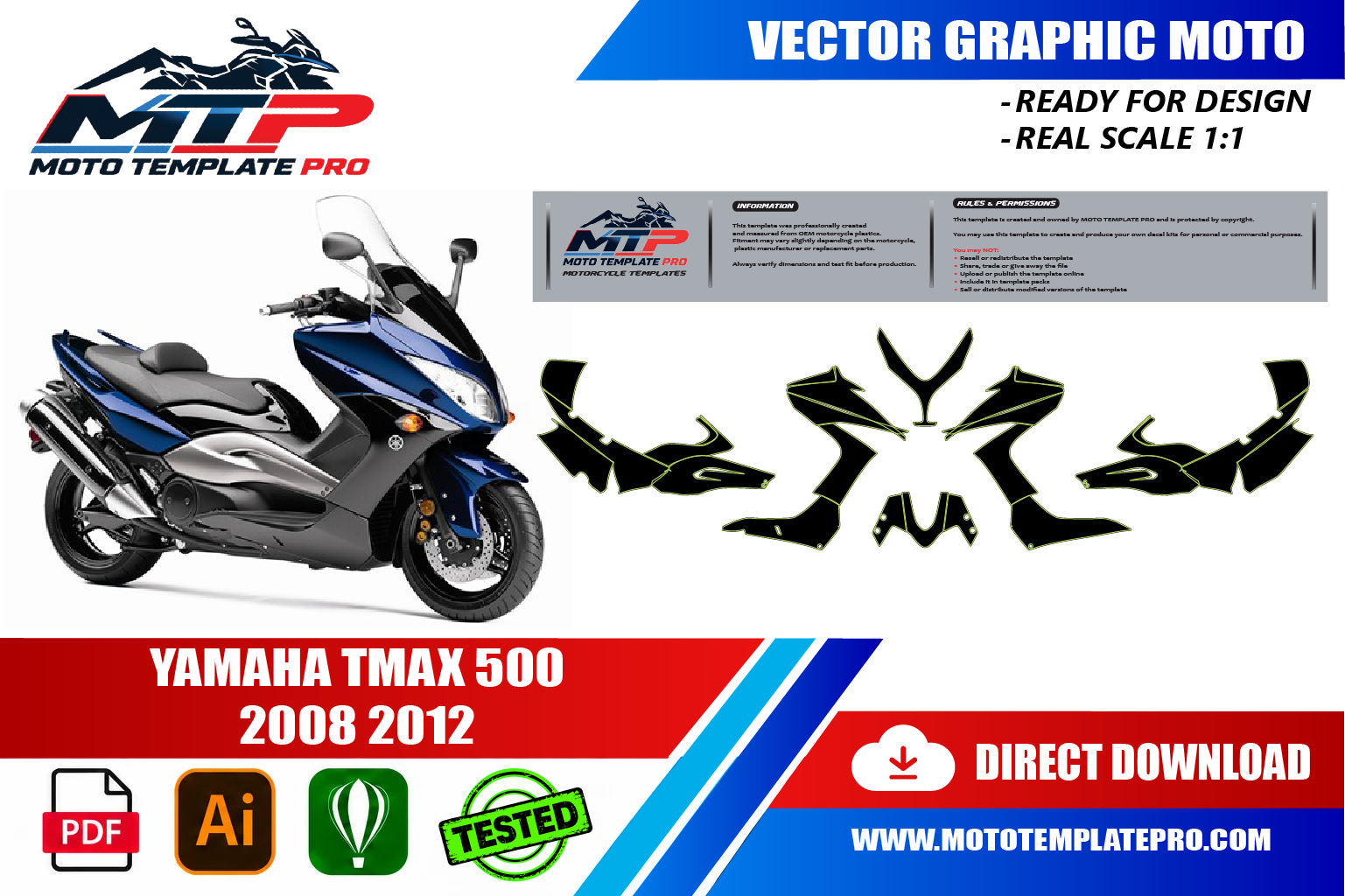
Yamaha TMAX 500 2008-2012 Vector Template
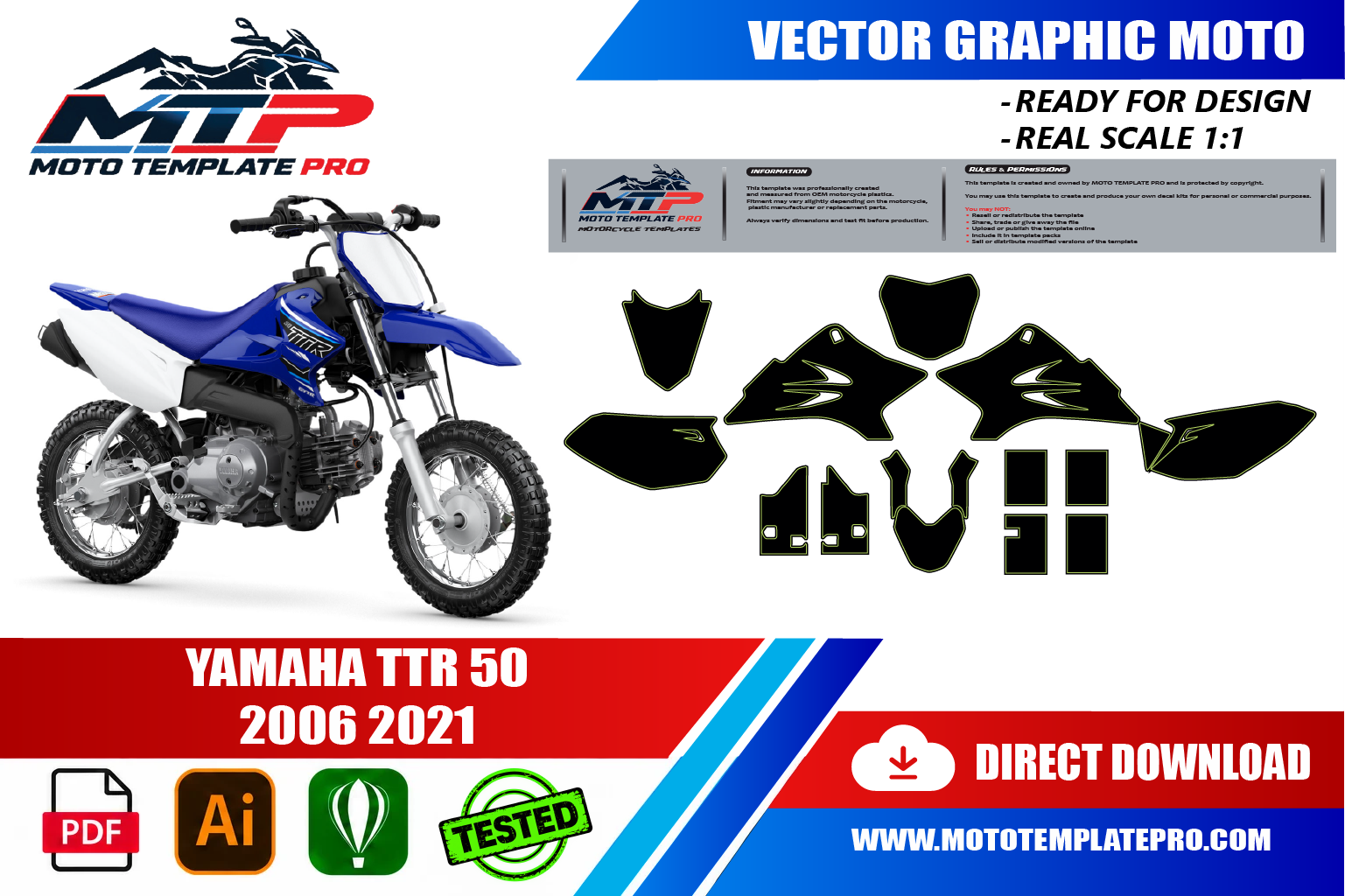
Yamaha TTR 50 2006-2021 Vector Template
Yamaha XMAX 125 300 2023-2025 Vector Template

Yamaha YZF R1 2007-2008 Vector Template


Reviews
There are no reviews yet.