
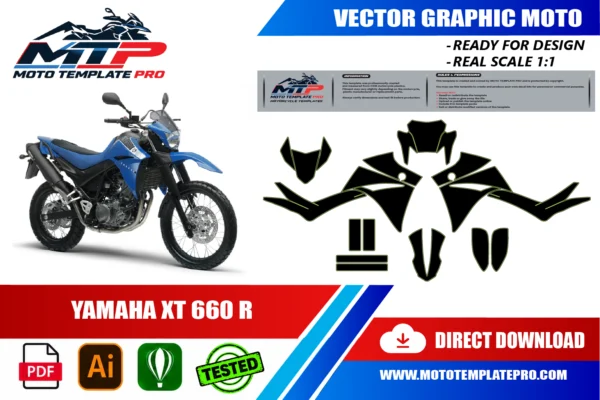


This Yamaha XT 660 R vector template reproduces the Yamaha XT 660 R at real scale (1:1) as an editable vector file.
Table of Contents
Yamaha XT 660 R Vector Template: Overview
Use this Yamaha XT 660 R vector template as an accurate base for decal kits, vinyl wraps, custom liveries and other graphics on the Yamaha XT 660 R. It is made for graphic designers, wrap installers and sticker manufacturers.
The Yamaha XT 660 R template is a design base for a single-cylinder dual-sport bike from Yamaha, a light and simple machine that many owners also convert to a supermotard look. We draw the panels of the Yamaha XT 660 R at actual 1:1 size, giving designers, wrap fitters and decal makers true shapes to build on in place of estimates taken from pictures.
You receive editable vector outlines in AI, PDF and CorelDRAW, with layers organised panel by panel. The file is a blank base for your own ideas, not a completed design, not a ready-cut decal kit and not a physical item. Yamaha is a trademark of its owner, and we are an independent design resource with no link to Yamaha.
The listing carries no model years, and we do not invent any. The Yamaha XT 660 R was sold for a long time, so a rider who owns an early example and a rider who owns a late one may see small differences in plastics and paint. Exact years are still to be verified, which is why exact outlines, a paper test and a dry fit matter more than assumptions.
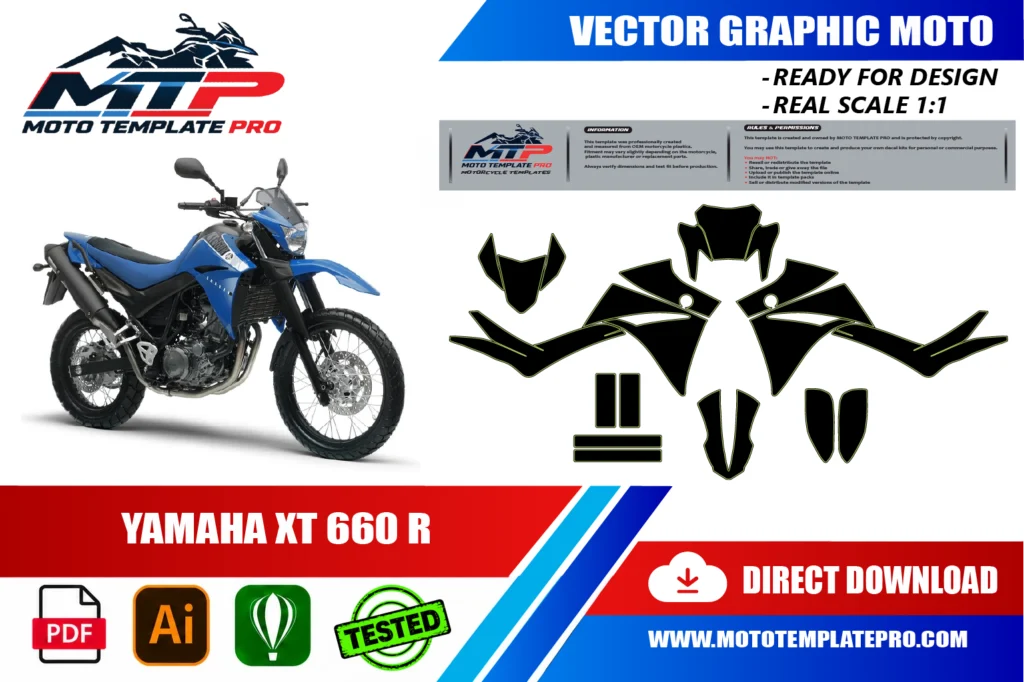
The template is provided as an editable vector file, compatible with Adobe Illustrator, PDF and CorelDRAW. It is a starting point for your own design work rather than a finished, ready-to-print graphic: a precise outline of the panels that you can use to position decals, plan a wrap layout or prepare a sticker kit at the correct scale. For background on why vector files are the standard for wrap and decal production, see the Adobe comparison of raster and vector formats.
Where the Yamaha XT 660 R comes from
According to the sources we checked, the XT 660 R belongs to the long XT line that began in 1976 and replaced the older XT 600 in Yamaha’s range. One database entry gives 2004 as the year of introduction, alongside a street-oriented supermotard sibling called XT 660 X, and says the last examples were built for South America in 2015 and 2016. Another encyclopedia entry notes only that the bike was no longer sold in some European countries after 2015.
These dates come from secondary sources and do not agree on every detail, so we treat them as clues and not as facts. For the Yamaha XT 660 R the safe approach is to read the year on your registration papers and keep it with your project. We have not confirmed the exact production years, and the listing deliberately has no years in its name.
The bike was sold mainly in Europe and, from 2005, in South America, according to one source. That matters because different markets sometimes received different colours, lamps or mirrors. If you bought your machine second-hand from another country, photograph the panels before you order.
The line also gives you a family to compare. The adventure version with the bigger tank has its own listing, and a rider who owns a Yamaha XT 660 R should not use those outlines for the nose or the tank.
If you are choosing between this listing and a neighbouring Yamaha one, compare the tank first. At about 15 litres, the tank of this bike is reported to be much smaller than that of the adventure version, and the covers around it follow that smaller shape.
What the name Yamaha XT 660 R means in our catalog
The listing is called Yamaha XT 660 R and we keep that name exactly as it appears in our catalog. XT is the family prefix for Yamaha’s dual-purpose singles, 660 refers to the engine class, and the letter R marks the on-road and off-road model as opposed to the adventure version with the Z and the street-oriented supermotard with the X.
Because there are no years in the name, the listing covers the bike as a model and not as a single season. We think that is honest. Where a source gives a different tank size, seat height or weight for different examples, we do not pick one. If you need to know whether your bike matches, send us the year and a photo of the left side.
You will also see XT660R written without spaces. All spellings point to the same bike. Our spacing is a catalog convention and nothing more, and it helps the search phrase match the way many owners write it.
A short question about your Yamaha XT 660 R project costs nothing. A wrong cut on a roll of vinyl costs a lot.
Engine and chassis facts behind the Yamaha XT 660 R
Sources describe a 660 cc liquid-cooled single-cylinder four-stroke with a single overhead camshaft, four valves and electronic fuel injection. Bore and stroke are quoted as 100 by 84 mm, with a five-speed gearbox and chain drive. Power is given as about 47 to 48 hp at 6,000 rpm and torque between 58 and 60 Nm, depending on the source. Treat all figures as claims.
The chassis is a light dual-sport layout: a 21-inch spoked front wheel, a 17-inch spoked rear wheel, a single 298 mm front disc, a 245 mm rear disc, a wheelbase near 1,500 mm and a fuel tank of about 15 litres. Weight is listed as 181 kg in two places. Seat height is given as 865 mm in one source and 895 mm in another, which shows how carefully you should handle datasheets.
Why does this matter to a designer? A small tank and a tall, narrow chassis give the Yamaha XT 660 R an upright, minimal look. There are few big flat areas, so each panel has to carry its share of the graphic, and white space becomes part of the design.
The single-cylinder engine also means vibration. Check that panel bolts and clips are tight before you work on your Yamaha XT 660 R, because a loose panel moves and can crease the vinyl at its edge.
Body panels of the Yamaha XT 660 R and how to read them
The bodywork is light and uncomplicated. As we understand it, the bodywork is made of a small front mask around the headlight, narrow tank covers, simple side panels under the seat and a short tail, but check this against your own bike. We did not find an official parts breakdown, and different markets may have used different covers, so the list below is a glossary of typical parts and not proof of what is drawn on each machine.
- Front mask and headlight surround
- Front mudguard
- Tank covers and tank sides
- Side panels and number-board areas
- Seat base and tail section
- Rear mudguard and plate area
You get 1:1 vector outlines in AI, PDF and CorelDRAW, with the layers sorted part by part. Hide the front mask while you work on the tail, or export a single part for a paper test. The product description says which pieces are included.
Some examples have been modified. Owners may swap the front mudguard for a short one, change the mask, fit smaller wheels for a supermotard look or add a rally-style screen. Photograph each part of your Yamaha XT 660 R with a ruler in the frame, so you know which plastics are original and which are replacements.
Before ordering, count the pieces on your bike and compare them with the list in the description. A machine with a front mask but no side panels, or the opposite, tells you something about the version you own.
Livery and graphics ideas for the Yamaha XT 660 R
A dual-sport single is a friendly canvas for bold ideas. Because the bike is narrow, simple shapes with strong contrast work better than lots of detail, and the supermotard crowd likes loud colour blocks. We did not verify the factory colours, so look at your plastics first.
- Supermotard street: a high-contrast two-colour split along the tank cover, with a big number on the front mask.
- Enduro classic: a white base with a single bright line from the mask to the tail.
- Trail tourer: matt grey with discreet tone-on-tone motifs on the tank covers.
- Paddock black: satin black with small coloured accents on the mudguards.
Short panels mean short lines, so avoid long stripes that have to break at several seams. Place one strong motif on the tank cover and let the mask and the tail carry quieter echoes of it.
A number board is the classic feature of this type of bike. On the Yamaha XT 660 R keep numbers inside the safe area of the panel, clear of the screws and of the edge where the front mudguard may rub, and use a plain heavy typeface that reads at speed.
Supermotard builds often favour very bright contrasts, but a design on a wet, muddy dual-sport bike is better with fewer colours. Two or three well-chosen tones print more cleanly, cost less to match and are easier to touch up if a panel is scratched.
Measuring, test-fitting and vinyl choices for the Yamaha XT 660 R
Add 3 to 5 mm of bleed past each outline and keep logos, numbers and small text off edges, bolts and seams. Print a paper copy at 100 percent, never scaled to fit, tape it on the real part and look from several angles. If it does not sit like the outline on screen, measure again before you cut any vinyl.
On a lightweight bike like the Yamaha XT 660 R, panels are thin and flexible, and they can twist when removed. Support the part on a flat bench with towels under it before you test the paper, and avoid pulling the vinyl while the panel is bent.
Use cast vinyl on curved areas such as the front mask and the mudguards, and calendered film for flat stripes. Follow the datasheet from the film maker and add a UV-resistant overlaminate. Off-road use means stones and mud, so a satin or matt finish hides small marks better than a high gloss.
Degrease with isopropyl alcohol, avoid silicone products and apply from the middle outwards. Use gentle heat only where the film must stretch, keep it clear of lamps and hot parts, and test adhesion on a hidden area first. Round every sharp corner of a small piece slightly, since square corners lift first.
File formats and compatibility cautions for the Yamaha XT 660 R
The template comes as AI, PDF and CorelDRAW files made of vector paths that can be scaled without loss. Most vector editors that read PDF will open the outlines, and Illustrator and CorelDRAW users can work in native files. We cannot test every program, so open the file and check a measured rectangle before you start.
Compatibility can vary with the year, the market and the parts fitted. Because the exact years are still to be verified, the supermotard version exists and many bikes have been modified, the outlines of the Yamaha XT 660 R are a base and not a promise of a fit for every example sold under that name.
The practical rule is simple: measure first and order afterwards. If you hesitate, send us a photo and the registration year, and we will help you compare with the outlines of your Yamaha XT 660 R.
Write the result of your scale check in the project notes. A rectangle of known length is enough, and any printer or cutter can repeat it in seconds.
How This Template Is Built
This Yamaha XT 660 R vector template is rebuilt as a fully editable vector outline from the real panel proportions of the Yamaha XT 660 R, rather than a rough tracing or a stretched photo. Working at true 1:1 scale means printers and installers can output panels straight from the file without rescaling, which keeps stripes, sponsor logos and pinstripes aligned exactly where they were designed.
Because the panel outlines are kept as separate, editable shapes, you can turn individual sections on or off while you design and export only the panels you actually need for production. On a vehicle of this kind (road-legal supermoto and enduro motorcycle), the typical panel groups include the front fender, tank shrouds, side panels, number plates and tail section. Before printing, always measure a panel on the real vehicle against the file, since small production differences can happen and a quick check avoids a costly reprint.
What You Can Use This Template For
- Supermoto and enduro decal kits
- Custom race and street liveries
- Number plate and rider name designs
- Full or partial vinyl wrap layouts
- Fender and tank shroud graphics
This Yamaha XT 660 R vector template suits riders and decal shops preparing a new graphics kit, wrap shops quoting jobs sight-unseen, and sticker manufacturers who need a reliable base file instead of starting from photographs. Because the panel outlines are separated rather than merged into one flattened shape, you can isolate a single panel and export only what you need, which saves time when a project only touches part of the vehicle.

Files Included and How to Use Them
After purchase you get an instant digital download of the Yamaha XT 660 R vector template in three formats. A typical workflow takes only a few steps:
- Download the file from your account or order email right after payment.
- Open the AI, PDF or CorelDRAW version in your vector software.
- Hide the panels you do not need and place your graphics, logos and colors on the rest.
- Print one test panel at 1:1 and check it against the real vehicle.
- Export the final artwork for your printer or cutter.
Printing, Scale and File Notes
Before you print this Yamaha XT 660 R vector template, remember that it is built at real 1:1 scale, so the safest workflow is to print a single test panel first and lay it against the actual Yamaha XT 660 R before committing to a full print run. A short test print is cheap insurance against a wasted roll of vinyl, especially around curved sections.
The vector layers are grouped by panel, which keeps the file manageable if you only need a subset of the panels, useful for a partial wrap, a single panel graphic or a small decal pack. If you run into a fitment question that is not covered here, reach out before you print. We would rather answer a quick question in advance than have you reprint a panel.

Also in our catalog: Yamaha NMAX 125 155 2021-2024 Vector Template, Yamaha MT-10 2022-2025 Vector Template, Yamaha YZF R1 2007-2008 Vector Template, Yamaha NMAX 125 2025 Vector Template, Yamaha MT-09 SP 2024-2026 Vector Template, Yamaha XMAX 300 2017-2022 Vector Template.
Browse all Yamaha vector templates.
Moto Template Pro is an independent design resource and is not affiliated with, endorsed by, or sponsored by Yamaha or any manufacturer.
Which model years does this Yamaha XT 660 R vector template cover?
This template is built specifically for the Yamaha XT 660 R.
Is the Yamaha XT 660 R template an official Yamaha product?
No. We are independent and not affiliated with Yamaha, whose name is a trademark of its owner. You get a vector template with real-size outlines to build your own artwork on, not a completed design, a sticker set or a physical item.
Which file formats come with the Yamaha XT 660 R template?
AI, PDF and CorelDRAW are included. All three carry 1:1 vector outlines sorted by part, so you can reshape them, add your design and send a cut file to a plotter.
Will the outlines fit every year of the Yamaha XT 660 R?
We cannot promise it. The exact production years are still to be verified, markets differed and many bikes have been modified. Hold a 100 percent paper print against your real panels before you cut vinyl.
Can I send the Yamaha XT 660 R file straight to a printer?
It is not print-ready artwork. Use it as a base, place your design inside the outlines, leave 3 to 5 mm of bleed, stay clear of edges and bolts with text, and check a paper test first.
Can the Yamaha XT 660 R template be used for a supermotard conversion?
It can serve as a base for the panels you keep, but the supermotard setup changes wheels and sometimes the front end, and the street-oriented XT 660 X is a separate model. Compare your parts with the outline before you start.
Is this template compatible with other models?
No. Each model and generation has different bodywork, so this template is specific to this platform and differs from every other template in our catalog.
What file formats are included?
The template is provided in Adobe Illustrator, PDF and CorelDRAW, all as editable vector layers rather than a flattened image.
How is the file delivered?
As an instant digital download available immediately after purchase, with no physical items shipped and no waiting on a production schedule.
Is this an official Yamaha product?
No. Moto Template Pro is an independent business, not affiliated with Yamaha.
Kawasaki 140 RL 2022 Vector Template

Kawasaki KX 125 250 Restyle 2003-2008 Vector Template
Kawasaki KXF 250 KX 250F 2009-2012 Vector Template
YAMAHA YZ85 2015 -2021 Vector Template


Reviews
There are no reviews yet.