


This Royal Enfield Himalayan 411 vector template reproduces the Royal Enfield Himalayan 411 at real scale (1:1) as an editable vector file.
Table of Contents
Royal Enfield Himalayan 411 Vector Template: Overview
Use this Royal Enfield Himalayan 411 vector template as an accurate base for decal kits, vinyl wraps, custom liveries and other graphics on the Royal Enfield Himalayan 411. It is made for graphic designers, wrap installers and sticker manufacturers.
The Royal Enfield Himalayan 411 template is made for the original Himalayan, the rugged single-cylinder adventure bike that put a practical, affordable tourer on roads from India to Europe. Our files draw the body panels of the Royal Enfield Himalayan 411 as vector outlines at real 1:1 scale, giving designers, vinyl-wrap installers and sticker makers a precise base for a bike with a simple, upright shape.
Each file contains editable contours in AI, PDF and CorelDRAW formats, with layers grouped by part. It is a design base for your own work, not a finished artwork ready to print, not a decal kit and not a physical item sent by post.
The Royal Enfield Himalayan 411 is a plain-spoken machine with a tall tank, a small screen and very little plastic, so every panel carries a lot of visual weight. A graphic that is a few millimetres off is easy to see on such clean surfaces, which is why starting from accurate outlines pays off before any vinyl is printed.
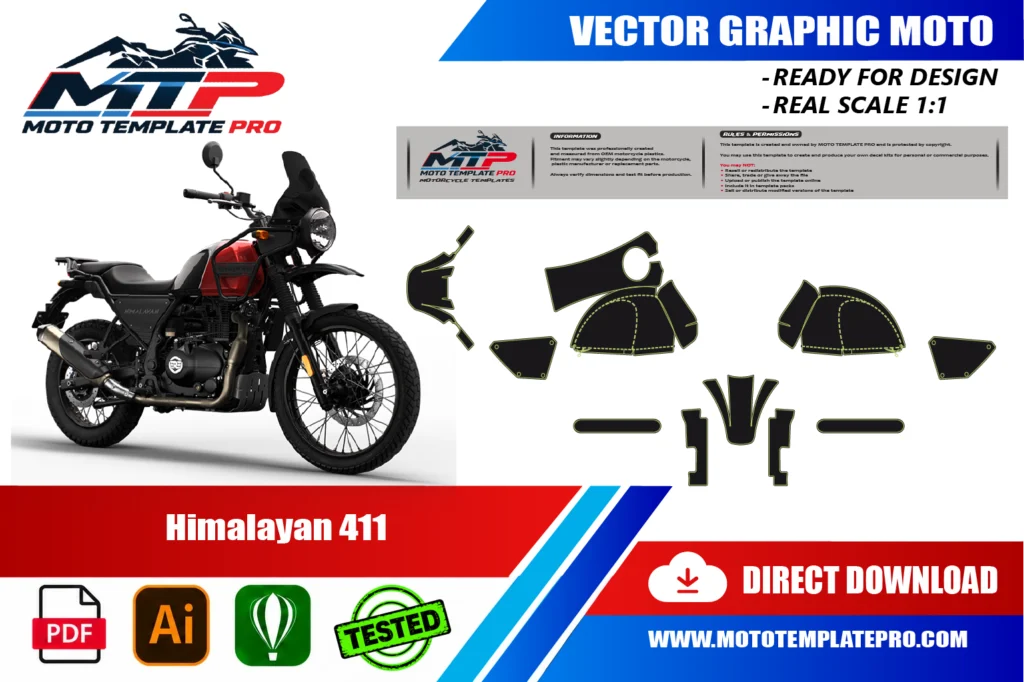
The template is provided as an editable vector file, compatible with Adobe Illustrator, PDF and CorelDRAW. It is a starting point for your own design work rather than a finished, ready-to-print graphic: a precise outline of the panels that you can use to position decals, plan a wrap layout or prepare a sticker kit at the correct scale. For background on why vector files are the standard for wrap and decal production, see the Adobe comparison of raster and vector formats.
Royal Enfield Himalayan 411: how the original Himalayan arrived
According to the sources we checked, the first Himalayan was revealed in early 2015, reached Indian showrooms in March 2016 and appeared in several international markets later that year. It was built in India, reportedly at the Chennai plant, and one reference lists production from 2016 to 2023, after which the newer Himalayan 450 became the only Himalayan on sale. We did not verify the exact end of production in every market.
The bike was designed as an honest all-rounder for poor roads: simple to repair, comfortable at modest speeds and happy to carry luggage. That character explains the bodywork. There are no big fairings to hide behind, only a handful of painted and moulded parts that a rider sees every day.
The name in this listing, Royal Enfield Himalayan 411, refers to this first-generation bike and its 411 cc engine. The later 452 cc Himalayan is a different machine with a different frame and different panels, so its shapes are not covered here. We are an independent design resource with no link to the manufacturer.
A word on the name: owners and sources write the bike as Himalayan 411, Himalayan 410 or simply the Himalayan, because the engine family was developed as the LS410 and later quoted as 411 cc. We use Royal Enfield Himalayan 411 throughout so that the file matches the listing.
Engine, frame and wheels of the Royal Enfield Himalayan 411
The engine is a 411 cc single-cylinder, four-stroke, SOHC unit with a bore of 78 mm and a stroke of 86 mm. Sources describe it as air-cooled with oil cooling support, and one reference gives 24.5 bhp at 6,500 rpm and 32 Nm of torque, driving a five-speed gearbox. Fuel injection and ABS were added around 2017, according to the references we saw.
The frame is a steel half-duplex split cradle. Reported figures include a 21-inch front wheel and a 17-inch rear wheel with spokes, a 41 mm telescopic fork, a rear monoshock, ground clearance of about 220 mm and a seat height around 800 mm. A fuel tank of about 15 litres is commonly listed, although one reference gives 15 or 17 litres depending on the variant, and we did not verify which is which.
Weight depends on the source and the year. A report on the BS6 update quotes 199 kg, while another reference lists 182 kg dry. For a designer the lesson is that these numbers describe mechanics, not plastics; the outline of a panel is something you confirm with a tape measure on your own bike.
The riding position is upright and the bike is narrow, so its panels are slim and tall rather than wide. Our outlines follow those proportions at full size, which helps when you must fit a long graphic on a tall, narrow tank. If you plan to carry luggage, remember that the rack and the tank guards also shape the bike. Note where the straps will cross the panels and avoid putting delicate lines there.
Naming the panels of the Royal Enfield Himalayan 411: tank, covers and mudguards
The Royal Enfield Himalayan 411 has a very different silhouette from a faired road bike. Reports mention front tank guards, an adjustable windscreen, jerrycan mounts, a luggage rack and mounts for aluminium panniers, so the bike carries more hardware than plastic. Catalogues differ in how they name the parts, so treat the list below as a glossary of typical sections and check it against the bike in your workshop.
- Fuel tank, with the area around the tank guards
- Headlight surround and the small windscreen area
- Front mudguard above the 21-inch wheel
- Side covers under the seat
- Rear mudguard and tail section around the rack
The template provides vector outlines at real 1:1 scale in AI, PDF and CorelDRAW, with layers grouped by part. We did not verify how each part is split in every year, nor whether metal fittings such as guards and racks are drawn, so read the product description to see which parts are included.
Photograph each part of your own bike with a ruler in the frame before you design. Guards, racks and aftermarket screens often hide the edges of the panels, and those photos tell you what the installer will really see.
Expedition and retro livery ideas for the Royal Enfield Himalayan 411
The 411 is a bike for roads that end. Its livery can borrow from maps, passes and old expedition kit instead of racing. According to a report on the BS6 update, colour choices included Snow White, Granite, Sleet Grey, Gravel Grey, Rock Red and Lake Blue. Other colours existed in other years and markets, and we did not verify them, so look at your own paint first.
Directions to try
- Pass profile: a thin line on the tank that traces the outline of a mountain pass, with the height in small numbers near the filler.
- Expedition crate: olive or sand panels with stencil-style numbers, as if the bike were packed for a long trip.
- Retro two-tone: a cream upper tank and a darker lower band, edged with a fine pinstripe.
- Prayer-flag accents: five narrow colour blocks that run along the mudguard, kept small so they do not dominate.
Because the tank is the biggest surface on the Royal Enfield Himalayan 411, give it one main idea and keep the side covers quiet. Use the mudguards for a small repeat of the accent colour, so the bike reads as one design.
Remember that luggage will hide the rear section. If the bike carries panniers or a rack bag, test the livery with them fitted before you decide where the strongest element goes.
A final idea for the tank: leave one side almost bare. Because the Royal Enfield Himalayan 411 has few large surfaces, a quiet side next to a busy side can look deliberate and calm. Test both versions on screen at actual size before you choose.
From outline to cut file for the Royal Enfield Himalayan 411
Open the file and rename the layers for your job, naming left and right sides explicitly. Lock finished panels so that a stray click cannot move an outline, and keep a clean copy of the original contours in a hidden layer.
Plan how graphics cross panel boundaries. On the Royal Enfield Himalayan 411 the tank, the side covers and the rear section meet at visible edges, so a continuous line must be drawn to match at each seam. Add registration ticks near the joins and write on the backing paper which piece goes where.
Extend your artwork beyond each contour by about 3 to 5 mm for bleed, and keep text, numbers and logos away from edges, tank guards, screws and the filler cap. Print a paper copy at 100 percent, never fit to page, tape it to the bike and look from several angles. The tank is curved, so a flat paper test shows where the vinyl will need to stretch.
Agree the colour workflow with your print partner: CMYK with the right profile, text converted to outlines and a separate spot colour for the cut path. Export a flattened proof for the client and keep a layered master with notes.
Wrapping the Royal Enfield Himalayan 411 for dust, rain and luggage
A bike that carries bags and sees gravel needs durable graphics. Choose quality cast vinyl for the curved tank and the mudguards, and keep calendered film for flat areas such as a straight stripe on a side cover. Follow the manufacturer’s datasheet for any film you buy.
Protect the print with a UV-resistant overlaminate. Satin hides fine scratches better than gloss and keeps colours livelier than flat matt, which helps on a bike that will be strapped with luggage. Pay special attention to the knee area of the tank, where jeans, buckles and boots rub constantly, and think about a clear protective film there.
Clean the plastic and metal with isopropyl alcohol and avoid silicone products. Position each piece with tape hinges and squeegee from the centre outwards, using gentle heat only where the film must stretch. Keep vinyl away from the filler cap, lamp lenses, sensors and the hot zones near the exhaust, and test adhesion on a hidden spot first.
Let the adhesive bond for a full day before the first wash or ride. Avoid pressure washers close to edges, and check them again after the first long trip, because a lifted corner is easy to press down early. Work in a clean, dust-free space if you can. A tall single-cylinder bike often lives in a garage that also holds tools and tyres, and a speck of grit under the film shows as a bump on a smooth tank. Wipe the panel, wait for it to dry, and keep the film covered until the last moment.
Compatibility cautions for the Royal Enfield Himalayan 411: BS4, BS6 and later years
The Royal Enfield Himalayan 411 was built for several years, and details changed. A report says the BS6 version appeared in January 2020 with a catalytic converter, a switchable rear ABS and a hazard switch, and a later report describes the 2021 bike as very similar to the 2020 one with a new side stand. None of these changes obviously alters the panels, but we did not verify it.
Many owners fit guards, racks, taller screens and luggage, and some bikes have been repainted. Compare the outline with your own panels by measuring the tank length, the mudguard width and the side cover height before printing. Photos of your own bike are always better than photos of someone else’s.
Compatibility can vary with the exact variant, year and parts fitted. The outlines are a design base, not a promise of a fit for every Royal Enfield Himalayan 411. Measure first, order afterwards, and send us a photo with the model year if you hesitate.
How This Template Is Built
This Royal Enfield Himalayan 411 vector template is rebuilt as a fully editable vector outline from the real panel proportions of the Royal Enfield Himalayan 411, rather than a rough tracing or a stretched photo. Working at true 1:1 scale means printers and installers can output panels straight from the file without rescaling, which keeps stripes, sponsor logos and pinstripes aligned exactly where they were designed.
Because the panel outlines are kept as separate, editable shapes, you can turn individual sections on or off while you design and export only the panels you actually need for production. On a vehicle of this kind (adventure or dual-sport bike), the typical panel groups include the tank shrouds, front fender, side panels and tail section. Before printing, always measure a panel on the real vehicle against the file, since small production differences can happen and a quick check avoids a costly reprint.
What You Can Use This Template For
- Adventure bike decal kits
- Tank and panel graphics
- Full or partial vinyl wrap layouts
- Expedition and sponsor branding
- Custom liveries
This Royal Enfield Himalayan 411 vector template suits riders planning a tank, panel or full wrap upgrade, wrap shops quoting jobs sight-unseen, and sticker manufacturers who need a reliable base file instead of starting from photographs. Because the panel outlines are separated rather than merged into one flattened shape, you can isolate a single panel and export only what you need, which saves time when a project only touches part of the vehicle.
Files Included and How to Use Them
After purchase you get an instant digital download of the Royal Enfield Himalayan 411 vector template in three formats. A typical workflow takes only a few steps:
- Download the file from your account or order email right after payment.
- Open the AI, PDF or CorelDRAW version in your vector software.
- Hide the panels you do not need and place your graphics, logos and colors on the rest.
- Print one test panel at 1:1 and check it against the real vehicle.
- Export the final artwork for your printer or cutter.
Printing, Scale and File Notes
Before you print this Royal Enfield Himalayan 411 vector template, remember that it is built at real 1:1 scale, so the safest workflow is to print a single test panel first and lay it against the actual Royal Enfield Himalayan 411 before committing to a full print run. A short test print is cheap insurance against a wasted roll of vinyl, especially around curved sections.
The vector layers are grouped by panel, which keeps the file manageable if you only need a subset of the panels, useful for a partial wrap, a single panel graphic or a small decal pack. If you run into a fitment question that is not covered here, reach out before you print. We would rather answer a quick question in advance than have you reprint a panel.

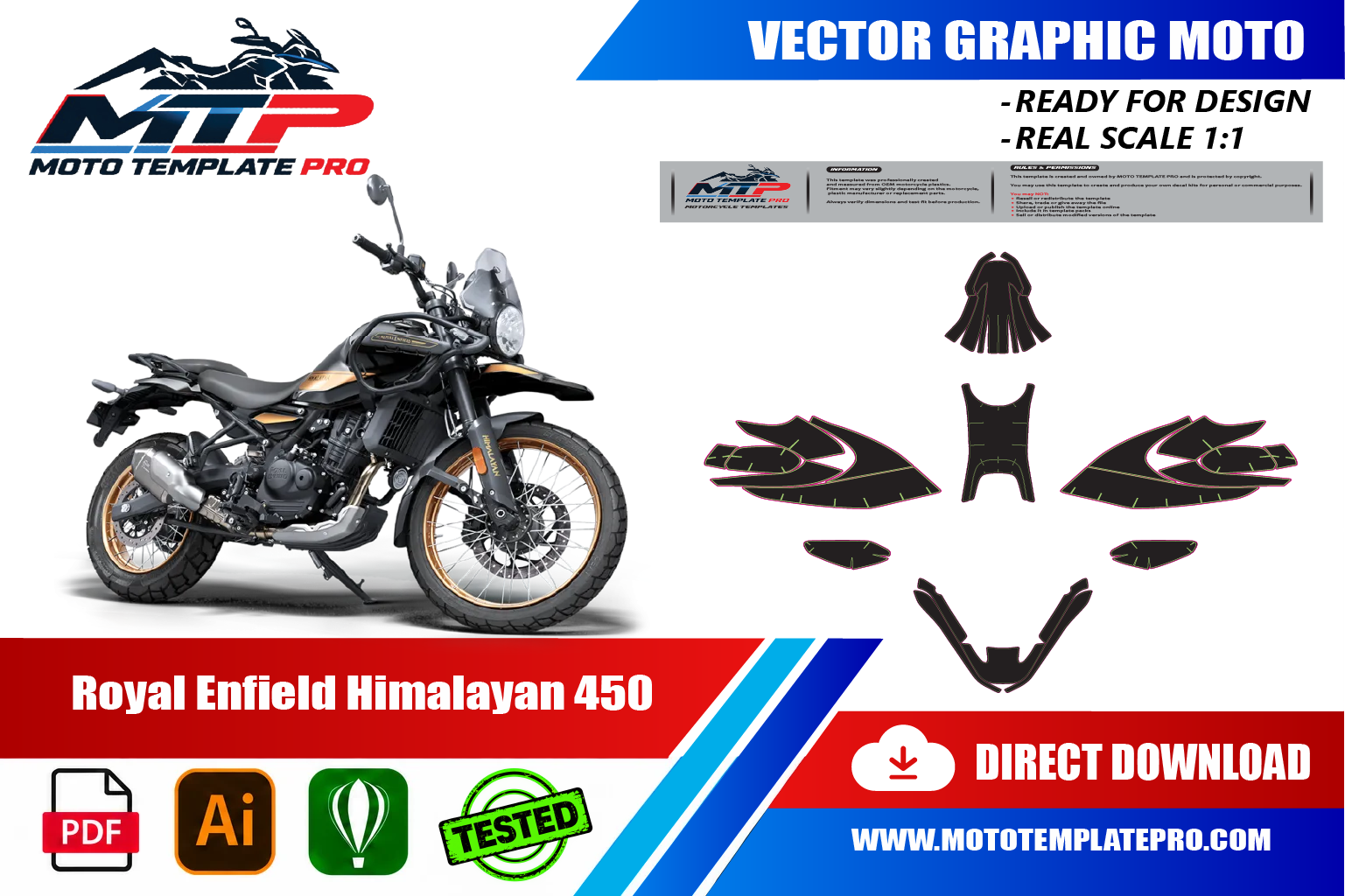
Also in our catalog: Royal Enfield Himalayan 450 Vector Template.
Browse all Royal Enfield vector templates.
Moto Template Pro is an independent design resource and is not affiliated with, endorsed by, or sponsored by Royal Enfield or any manufacturer.
Which model years does this Royal Enfield Himalayan 411 vector template cover?
This template is built specifically for the Royal Enfield Himalayan 411.
What is the Royal Enfield Himalayan 411?
It is the first-generation Himalayan, an adventure-style bike with a 411 cc single-cylinder engine, launched in India in 2016 and reportedly built until about 2023. Our template covers the outlines of its body panels only, not the mechanical parts.
Which file formats come with the Royal Enfield Himalayan 411 template?
The outlines are vector files in AI, PDF and CorelDRAW, at real 1:1 scale, with layers grouped by part. Use the AI or CorelDRAW file to edit and the PDF to view or print a paper test.
Does the Royal Enfield Himalayan 411 template also fit the newer Himalayan 450?
No. The newer bike has a different engine, frame and bodywork, so a 411 outline should not be used on it. Choose the file that matches your bike and compare it with your panels before printing.
Is the Royal Enfield Himalayan 411 template a finished decal kit?
No. It is a design base: outlines to fill with your own colours, patterns and text. You create, print and cut the graphics yourself or with a print partner, and nothing physical is shipped.
Which part of the Royal Enfield Himalayan 411 is the best first project?
The fuel tank is the natural start: large, visible and shaped for one clear idea. Practise your method there, then move to the mudguards and side covers, which are smaller and need tighter alignment.
Is this template compatible with other models?
No. Each model and generation has different bodywork, so this template is specific to this platform and differs from every other template in our catalog.
What file formats are included?
The template is provided in Adobe Illustrator, PDF and CorelDRAW, all as editable vector layers rather than a flattened image.
How is the file delivered?
As an instant digital download available immediately after purchase, with no physical items shipped and no waiting on a production schedule.
Is this an official Royal Enfield product?
No. Moto Template Pro is an independent business, not affiliated with Royal Enfield.
Royal Enfield Himalayan 450 Vector Template


Reviews
There are no reviews yet.