
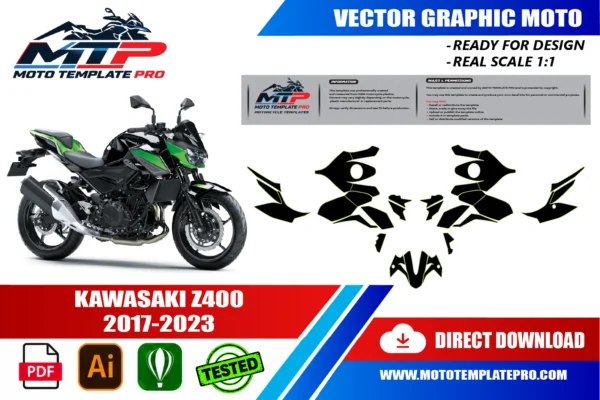

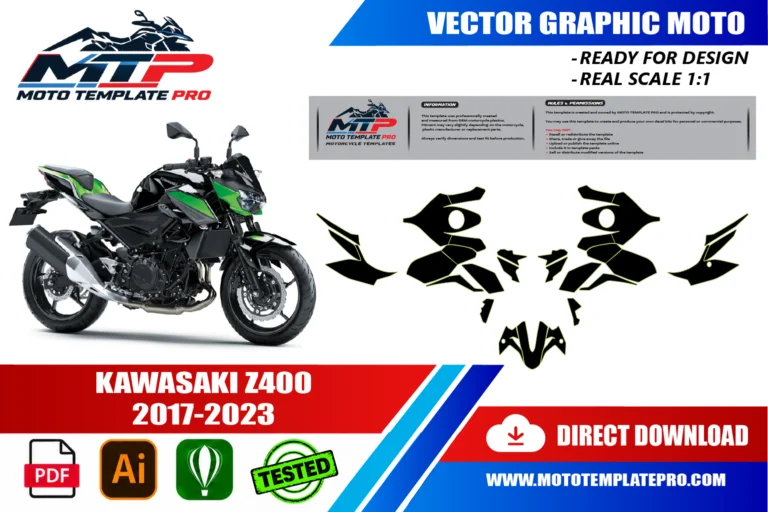
This Kawasaki Z400 2017-2023 vector template reproduces the Kawasaki Z400 2017-2023 at real scale (1:1) as an editable vector file.
Table of Contents
Kawasaki Z400 2017-2023 Vector Template: Overview
Use this Kawasaki Z400 2017-2023 vector template as an accurate base for decal kits, vinyl wraps, custom liveries and other graphics on the Kawasaki Z400 2017-2023. It is made for graphic designers, wrap installers and sticker manufacturers.
The Kawasaki Z400 2017-2023 is the entry-level naked bike of Kawasaki’s Z family: a light, approachable roadster built on the same 399 cc parallel-twin platform as the Ninja 400, but with the full fairing removed and a sharper, more upright look. It is a popular first big bike for young riders, and a natural canvas for a first custom livery.
Small bikes show their personality through graphics. A compact tank, a short tail and a small headlight cowl leave less room than on a larger naked bike, so every stripe and shape counts, and good planning matters more than complicated artwork.
This template gives you editable vector outlines at real 1:1 scale, delivered in AI, PDF and CorelDRAW with layers grouped by part. It is a starting point for your own artwork, not a finished print file, and it is not official or manufacturer-approved.

The template is provided as an editable vector file, compatible with Adobe Illustrator, PDF and CorelDRAW. It is a starting point for your own design work rather than a finished, ready-to-print graphic: a precise outline of the panels that you can use to position decals, plan a wrap layout or prepare a sticker kit at the correct scale. For background on why vector files are the standard for wrap and decal production, see the Adobe comparison of raster and vector formats.
The Kawasaki Z400 2017-2023 and its Ninja 400 roots: what we verified
Start with an honest note about dates. The range in the name, 2017-2023, follows the template listing. What we verified is that the Z400 was announced at the EICMA show in late 2018 and sold as a 2019 model, so we could not confirm a Z400 from 2017 or 2018. If your bike is older than 2019, compare it very carefully with the outline. The Kawasaki Z400 2017-2023 listing might cover bikes sold under other names in some markets, but we did not verify that.
The family link is clear. Launch coverage describes the Z400 as fundamentally the same bike as the Ninja 400: the same 399 cc parallel-twin, which also acts as a stressed part of the frame, an adapted steel trellis frame with a short wheelbase and a longer swingarm, and ABS fitted on the version reviewed. The naked bike adds a higher handlebar and an S-shaped tank profile for a more relaxed riding position.
Sugomi in miniature
Kawasaki gave the Z400 the Sugomi design language of its bigger naked bikes: sharp angles and lines, with the full fairing replaced by a smaller cowl around a single headlight. We did not verify differences between each model year after 2019, including colour updates, so treat any year-specific claim with care and check the actual bike.
Panel by panel on the Kawasaki Z400 2017-2023
A naked bike like the Kawasaki Z400 2017-2023 has no full fairing, so the graphics live on a few compact pieces. The fuel tank is the central canvas, with its S-shaped profile rising from the seat toward the steering head. Around it, shrouds or side covers shape the flanks, depending on how the bike is split. Up front, the headlight cowl surrounds the lamp and the front fender sits low over the wheel.
Under the seat, side covers lead back to the tail section, which finishes the line over the rear wheel. We describe the parts in plain words because the exact split can vary, so check each outline against your own bike.
- Largest surfaces: tank top and flanks, which carry the main graphic.
- Medium pieces: side covers and tail section, good for a repeated accent.
- Small pieces: headlight cowl and front fender, best with one simple shape or a solid colour.
Layers are grouped by part, so you can see how a design reads on the tank alone and then bring the other pieces back. Because the panels are small, nothing is hidden by distance: any wobble in a line is visible from a metre away, so draw with confident, smooth curves.
A little vocabulary helps when you brief a printer: call the flanks of the tank shrouds, the small cowl the headlight cowl, and the rear bodywork the tail section.
City livery ideas for the Kawasaki Z400 2017-2023
The Kawasaki Z400 2017-2023 spends much of its life in traffic, so city-inspired liveries make sense. Think about what the bike faces every day: parking lots, night rides, rain and sun. A livery can be fun and practical at the same time.
Three urban directions
- Night rider: a dark base with narrow reflective-style accents on the tail and side covers, which catch headlights. Check local rules and the film maker’s specification before relying on any film for safety.
- Pastel café: two soft colours, such as mint and cream, split along the tank flank with a thin outline stripe. It reads friendly and clean.
- Sticker-bomb panels: a collage of original shapes and badges on the side covers and tail only, with the tank kept plain so the bike does not look cluttered.
Young riders often want the bike to say something, so consider initials or a small mark on the tail, designed by you rather than copied from a brand. Brand-inspired colours are fine, but leave out logos and wordmarks.
Because the bike is light and compact, a bold graphic can overwhelm it. Keep to two or three colours, leave breathing room around the headlight cowl, and test your design as a thumbnail: if the idea is still clear when tiny, it will read from across the street.
Think about where the bike will be parked, too. A livery that looks great in a garage may disappear under a street lamp, so check your colours outdoors in daylight and at dusk before you commit the film.
Your first wrap: from outline to cut file on the Kawasaki Z400 2017-2023
If this is your first project, work in small steps. Open the template at 100 percent, lock the outline group and build your artwork on separate layers above it. In the Kawasaki Z400 2017-2023 file each part has its own grouped layer, so you can start with one panel, such as a side cover, before attempting the tank.
Extend the artwork beyond the contour so the film can wrap the edge; many installers use roughly 5 to 10 mm, less on flat areas, but ask your installer or print shop. Put the cut line on its own layer as a spot colour, add registration marks, convert text to outlines and use the colour profile that your printer supplies.
Print one panel on paper at 100 percent and tape it to the bike. Because the panels are small, this takes a few minutes and reveals scale mistakes instantly. Adjust your artwork where the paper differs from the real part, then export one file per part.
Keep a master file with every layer, and save a cut-only version for the plotter. If you share files with a friend who owns a cutting machine, give simple instructions: scale 100 percent, colour profile and which layer is the cut line. Clear notes prevent most first-time errors.
Vinyl and laminate for a small naked bike that gets ridden every day
A small naked bike is often a daily rider, so choose weatherproof materials. Cast vinyl follows the curves of the tank flanks and keeps its shape, which makes it the safer choice there. Calendered film is stiffer and cheaper and suits flat pieces such as a straight stripe on a side cover. Always follow the manufacturer datasheet.
A clear laminate protects printed ink from rain, UV light, fuel splashes and car washes. Gloss gives depth, matte hides fingerprints and small flaws, and satin is a calm compromise. Use the same laminate across all pieces so the colours match in sunlight and under street lamps.
Clean the surface with isopropyl alcohol after removing wax and polish. Apply the film from the centre outward with a squeegee, use only gentle heat to relax it over curves, and avoid overstretching printed areas, which thins the colour. Round the corners of small pieces by a millimetre or two, since sharp points are the first to lift.
Give the adhesive a few days before the first wash, and hand wash for the first weeks. Keep film away from hot parts, and test a hidden spot on textured plastic before committing, because rough surfaces hold less reliably than smooth paint.
Edges deserve patience. Where two pieces of film meet, a one-millimetre overlap looks neater than a gap, and an edge primer made for vinyl can help where film folds over an older paint job.
Beginner mistakes on a small roadster project
First projects share the same traps. These are the ones to avoid.
- Graphics too big for a small bike: large shapes crowd the compact tank. Scale down and leave empty space.
- Thin lines and tiny text: they lift or vanish on curves, especially around the headlight cowl.
- Skipping surface prep: wax, polish and road film make edges peel.
- Overstretching film: printed colour thins and stripes distort.
- Scaling in the print dialog: fit to page ruins the 1:1 scale. Print at 100 percent.
Another common mistake is working in a hurry. Remove the plastic panels if you can, lay them on a clean table and apply the film calmly, rather than fighting a curved surface while the bike sits on a stand.
Finally, small bikes get dropped and scuffed, especially in the first year. Keep a spare print of the tank flanks and side covers, and save the original file, so that a repair can be matched later.
Z400 launched in 2019: how to read the Kawasaki Z400 2017-2023 range
The Z400 reached riders as a 2019 model, after the announcement in late 2018. The template name starts earlier, in 2017, because it follows the listing, so do not read the range as a statement that a Z400 existed in 2017. If you own a bike from 2019 to 2023, expect broadly the same naked bodywork, but we did not verify differences between each model year, including later colour updates.
Do not mix it up with its fully faired sibling. The Ninja 400 shares the engine and much of the platform, but it wears a full fairing, so its panels differ from the naked bodywork of the Kawasaki Z400 2017-2023. Larger Z models also have their own shapes and are not interchangeable.
Compare the headlight cowl, tank flanks, side covers and tail with the preview images. Note aftermarket parts: a tail tidy, a fly screen, tank pads or frame sliders can change what you see and where graphics can go.
Compatibility can vary with exact variant, year and aftermarket parts, so compare the outline with the real panels before printing. Write down your findings, including year and colour, then send photos of your Kawasaki Z400 2017-2023 to the shop if anything looks doubtful.
If a friend or a customer will own the finished bike, share your checklist with them as well. It explains the model range, the variant and the parts you checked, which avoids confusion when the kit is delivered.
How This Template Is Built
This Kawasaki Z400 2017-2023 vector template is rebuilt as a fully editable vector outline from the real panel proportions of the Kawasaki Z400 2017-2023, rather than a rough tracing or a stretched photo. Working at true 1:1 scale means printers and installers can output panels straight from the file without rescaling, which keeps stripes, sponsor logos and pinstripes aligned exactly where they were designed.
Because the panel outlines are kept as separate, editable shapes, you can turn individual sections on or off while you design and export only the panels you actually need for production. On a vehicle of this kind (naked or roadster motorcycle), the typical panel groups include the headlight cowl, tank shrouds and covers, side panels, front fender and tail section. Before printing, always measure a panel on the real vehicle against the file, since small production differences can happen and a quick check avoids a costly reprint.
What You Can Use This Template For
- Naked bike decal kits
- Tank and shroud graphics
- Tail and side panel designs
- Full or partial vinyl wrap layouts
- Custom liveries
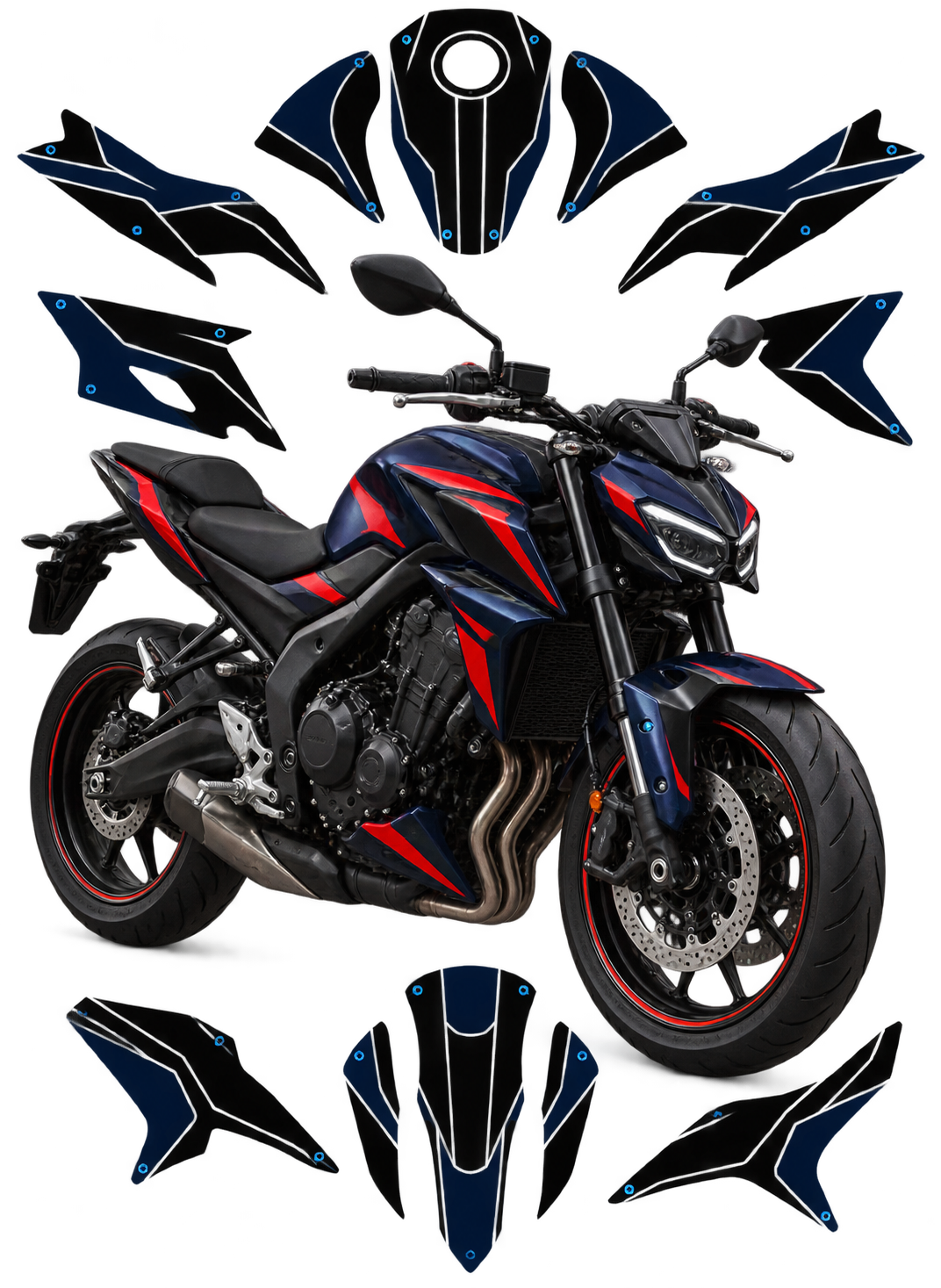
This Kawasaki Z400 2017-2023 vector template suits riders and decal shops planning a tank, shroud and tail graphics kit, wrap shops quoting jobs sight-unseen, and sticker manufacturers who need a reliable base file instead of starting from photographs. Because the panel outlines are separated rather than merged into one flattened shape, you can isolate a single panel and export only what you need, which saves time when a project only touches part of the vehicle.
Files Included and How to Use Them
After purchase you get an instant digital download of the Kawasaki Z400 2017-2023 vector template in three formats. A typical workflow takes only a few steps:
- Download the file from your account or order email right after payment.
- Open the AI, PDF or CorelDRAW version in your vector software.
- Hide the panels you do not need and place your graphics, logos and colors on the rest.
- Print one test panel at 1:1 and check it against the real vehicle.
- Export the final artwork for your printer or cutter.
Printing, Scale and File Notes
Before you print this Kawasaki Z400 2017-2023 vector template, remember that it is built at real 1:1 scale, so the safest workflow is to print a single test panel first and lay it against the actual Kawasaki Z400 2017-2023 before committing to a full print run. A short test print is cheap insurance against a wasted roll of vinyl, especially around curved sections.
The vector layers are grouped by panel, which keeps the file manageable if you only need a subset of the panels, useful for a partial wrap, a single panel graphic or a small decal pack. If you run into a fitment question that is not covered here, reach out before you print. We would rather answer a quick question in advance than have you reprint a panel.

Also in our catalog: Kawasaki Z650 2020-2022 Vector Template, Kawasaki Z900 2020-2024 Vector Template, Kawasaki Z900 2017-2019 Vector Template, Kawasaki Z1000 2014-2023 Vector Template, Kawasaki Z750 2007-2014 Vector Template, Kawasaki Z900 2025-2026 Vector Template.
Browse all Kawasaki vector templates.
Moto Template Pro is an independent design resource and is not affiliated with, endorsed by, or sponsored by Kawasaki or any manufacturer.
Which model years does this Kawasaki Z400 2017-2023 vector template cover?
This template is built specifically for the Kawasaki Z400 2017-2023.
Is the Kawasaki Z400 2017-2023 template the same as one for the Ninja 400?
No. The Ninja 400 shares the engine and platform, but it has a full fairing that the naked bike does not. This template follows the naked bodywork of the Kawasaki Z400 2017-2023 only, and we do not claim it fits any faired model. Compare the outline with your real panels before printing.
Can a beginner apply a kit to the Kawasaki Z400 2017-2023 at home?
Yes, if you start small. Practise on a flat side cover, work in a clean room and use cast film with a squeegee and gentle heat. The panels of the Kawasaki Z400 2017-2023 are compact, which makes mistakes cheaper. Do the tank last, and ask an experienced installer if you feel unsure.
How can graphics make the Kawasaki Z400 2017-2023 easier to see at night?
Use light colours or reflective-style film on the tail and side covers, where following drivers see them. A film is never a substitute for proper lights and clothing. Check the film maker’s specification and your local rules, and keep the pattern simple so it stays readable on the Kawasaki Z400 2017-2023.
Where should initials or a small mark go on the Kawasaki Z400 2017-2023?
The tail section and the rear part of the side covers are popular spots, because they are visible to other road users and relatively flat. Keep the mark small, centred by eye and away from panel gaps. On the Kawasaki Z400 2017-2023, avoid deep curves where letters would stretch.
Was the Kawasaki Z400 2017-2023 sold from 2017?
We could only verify that the Z400 was announced in late 2018 and sold as a 2019 model. The 2017 start in the name follows the template listing. If your bike is older than 2019, check carefully before ordering, and send us photos of the Kawasaki Z400 2017-2023 you own if you are unsure.
Is this template compatible with other models?
No. Each model and generation has different bodywork, so this template is specific to this platform and differs from every other template in our catalog.
What file formats are included?
The template is provided in Adobe Illustrator, PDF and CorelDRAW, all as editable vector layers rather than a flattened image.
How is the file delivered?
As an instant digital download available immediately after purchase, with no physical items shipped and no waiting on a production schedule.
Is this an official Kawasaki product?
No. Moto Template Pro is an independent business, not affiliated with Kawasaki.


Reviews
There are no reviews yet.