
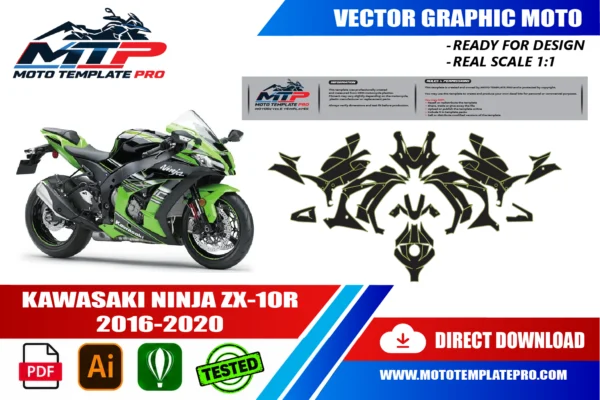


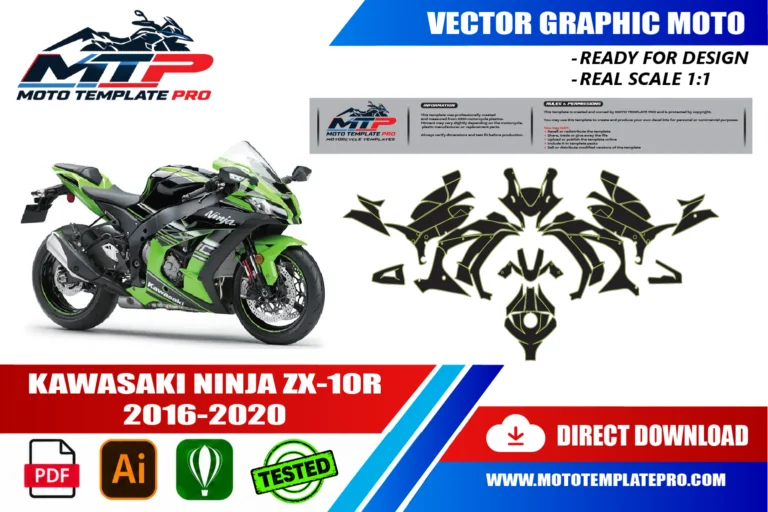
This Kawasaki Ninja ZX-10R 2016-2020 vector template reproduces the Kawasaki Ninja ZX-10R 2016-2020 at real scale (1:1) as an editable vector file.
Table of Contents
Kawasaki Ninja ZX-10R 2016-2020 Vector Template: Overview
Use this Kawasaki Ninja ZX-10R 2016-2020 vector template as an accurate base for decal kits, vinyl wraps, custom liveries and other graphics on the Kawasaki Ninja ZX-10R 2016-2020. It is made for graphic designers, wrap installers and sticker manufacturers.
The Kawasaki Ninja ZX-10R 2016-2020 template is made for the superbike that Kawasaki rebuilt around the World Superbike paddock: a 998 cc inline-four, an aggressive nose with a central air intake, tight side fairings and a short, pointed tail. Every surface is shaped by function, and that makes it one of the most graphic-friendly bikes you can work on.
A superbike is also one of the most demanding canvases. Panels are small, compound curves are everywhere and the viewer expects precision. Placing a number, a stripe or a colour break on the Kawasaki Ninja ZX-10R 2016-2020 means thinking about airflow, light and the way the rider sits behind the screen.
These editable vector outlines show the body panels at 1:1, with layers grouped by part, so you can plan the artwork on real geometry instead of guesswork. They are a starting point for your own design, not a finished image ready for print. The creative decisions stay entirely yours.
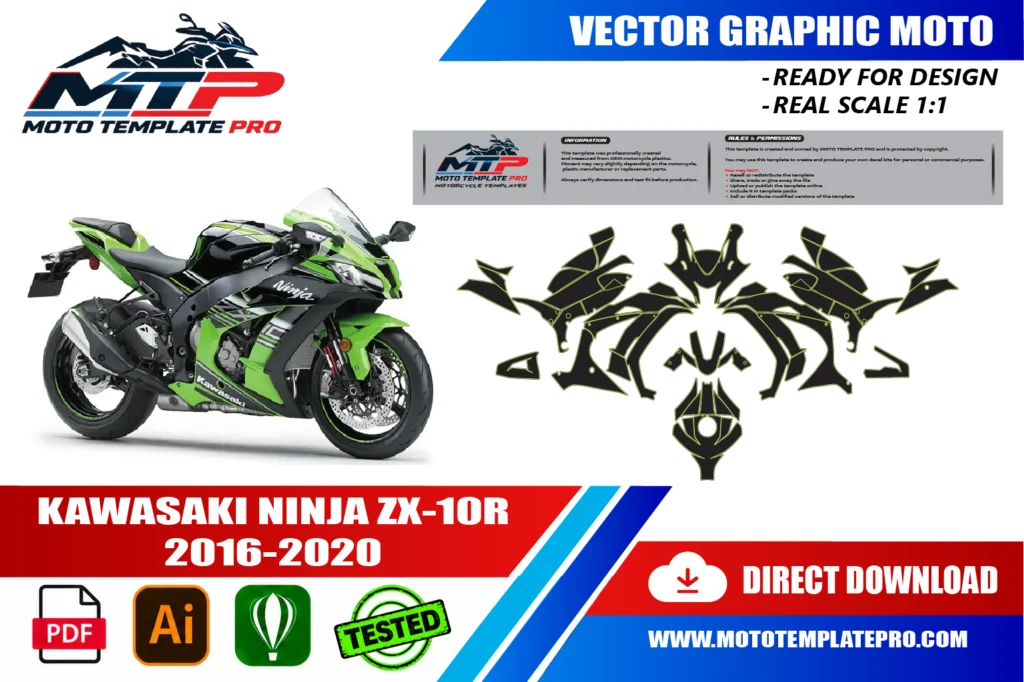
The template is provided as an editable vector file, compatible with Adobe Illustrator, PDF and CorelDRAW. It is a starting point for your own design work rather than a finished, ready-to-print graphic: a precise outline of the panels that you can use to position decals, plan a wrap layout or prepare a sticker kit at the correct scale. For background on why vector files are the standard for wrap and decal production, see the Adobe comparison of raster and vector formats.
How the Kawasaki Ninja ZX-10R 2016-2020 fits into the ZX-10R story
The ZX-10R arrived in 2004 and has been redesigned several times since. The 2011 to 2015 generation brought traction control, a Showa Big Piston Fork and three-spoke wheels. The Kawasaki Ninja ZX-10R 2016-2020 generation followed with a deeper update, built on a 998 cc engine with lighter internals and a new gearbox.
The electronics grew just as much: a Bosch five-axis inertial unit, launch control, a quickshifter, engine-brake control and an optional cornering ABS. Brakes moved to Brembo M50 monobloc calipers with 330 mm discs, and the Showa fork was described as derived from World Superbike practice.
Within the period, a limited ZX-10RR with race-oriented parts was built, and a special edition with semi-active suspension and a hard-wearing paint was offered. In 2019 a new valve train and an autoblipper arrived, with new colours for the standard bike. The Kawasaki Ninja ZX-10R 2016-2020 also carries the sporting pedigree of Jonathan Rea’s 2015 World Superbike title.
The 2021 bike introduced a new look with more aerodynamic bodywork, which is why the 2016 to 2020 shapes should be treated as their own family.
For designers, the practical takeaway is simple: an adjective like “new” in an advert tells you little. Compare the nose, the air intake and the tail of your Kawasaki Ninja ZX-10R 2016-2020 with the outlines instead. Colours and graphics on factory bikes also change from one year to the next, so do not rely on a paint name alone.
The body panels of the Kawasaki Ninja ZX-10R 2016-2020, from nose to tail
Superbike vocabulary is precise, so learn it. The nose, or upper fairing, houses the headlights and the central air intake that feeds the airbox. The screen sits above it. The two side fairings run down the flanks, and the lower fairing, often called the belly pan, closes the underside around the engine.
Behind the rider, the fuel tank is topped by a tank cover on many bikes of this type, and the seat unit ends in the tail section with its side panels. The front fender and the rear hugger complete the set. The small mirror covers and the panels around the air ducts are useful for accents, but they also interrupt long lines.
Where the eye lands first
- Nose: the face, and the natural home of a race number.
- Side fairings: the largest flat-ish areas, ideal for a long line or a name.
- Tank cover: a strong shape that connects the cockpit to the tail.
- Tail section: short, sharp and perfect for numbers or small details.
Because the panels are layered by part, you can isolate the nose and test a number placement before adding anything else.
Hardware matters too. Fasteners, small inserts and the seams between fairings define where a graphic can safely end. Walk around the Kawasaki Ninja ZX-10R 2016-2020 and mark those lines with masking tape before you draw; it teaches you more than a photograph about how each panel meets its neighbour.
Race-bred livery ideas for the Kawasaki Ninja ZX-10R 2016-2020
Racing heritage is the natural starting point. A superbike livery usually has three zones: the nose with a number, the side fairings with the main graphic and the tail with a secondary number. The Kawasaki Ninja ZX-10R 2016-2020 handles this structure beautifully because its panels are compact and clearly separated.
Try a hard colour split diagonally from the nose to the lower fairing, with a fine contrast line along the edge. Geometric shapes and sharp angles echo the aggressive face of the bike better than soft curves. For a subtler result, a monochrome matte design with gloss numbers and lines looks purposeful and costs little extra.
If you want a sponsor-style layout, invent your own names and shapes instead of copying real teams or brands. A strong grid of fictional blocks, set at consistent distances from the panel edges, reads as professional from a distance.
Keep colour changes at panel seams when possible. A break that falls on a seam hides small differences in alignment between the parts.
Think about light as well. A gloss black base with matte graphics reads differently at dawn and at noon, and metallic flakes can make a small panel look busy. On a superbike, strong contrast and flat colours usually communicate speed better than complex effects.
Working the Kawasaki Ninja ZX-10R 2016-2020 template from file to kit
Start with a 1:1 print of the nose and one side fairing. Hold the paper against the bike and see how the design reads from three metres away, not only on screen. The outlines are at full scale, so any mismatch comes from your printer settings or from a part that differs from the standard shape.
Keep the original contours locked on their own layers and build the artwork on separate ones. Add a bleed, usually a few millimetres, on edges that wrap, and put your cut path on a spot-colour layer. Add registration marks outside the artwork and convert all text to outlines.
Because the left and right sides are mirrored, decide early whether the design is symmetrical. Name the layers clearly and number the pieces in the order you will fit them. For the colour, work in the profile supplied by your print shop and proof a small piece on real film before the full run.
When a customer asks for a change on their Kawasaki Ninja ZX-10R 2016-2020, return to the untouched master file instead of editing the production file.
If you plan a full kit, set up a simple checklist: nose, left fairing, right fairing, lower fairing, tail and fenders. Tick each piece after proofing, cutting and fitting. This avoids a missing part on the day of the build and keeps the Kawasaki Ninja ZX-10R 2016-2020 project organised.
Materials and fitting for the Kawasaki Ninja ZX-10R 2016-2020
Use cast vinyl for the nose, the lower fairing and the tail. These parts have deep compound curves, and a thin, conformable film follows them with fewer creases. Calendered film can work on flatter areas but may recover its flat shape at the edges. A clear laminate, gloss or matte, protects against fuel, chain oil and UV.
Clean every panel with isopropyl alcohol and remove old wax. If fasteners hold the part, remove it from the bike when possible and fit the film on a bench. Start from the centre, work air outward and use gentle heat only to relax the film over curves.
For track use, think about stone chips and abrasion. A thicker laminate or a clear protective film on leading edges can add resilience, but it changes the finish, so test first. Wrap the edges around the panel when the shape allows, and trim openings cleanly after the film has settled.
Let the adhesive rest for a day or two before riding hard or washing, and avoid aggressive pressure washers near edges.
Temperature affects everything. Fit the film in a room that is comfortable for you, because cold vinyl is stiff and a hot panel makes the adhesive grab too early. If you work on a Kawasaki Ninja ZX-10R 2016-2020 that has just been ridden, let the fairings cool completely first.
Mistakes that spoil a Kawasaki Ninja ZX-10R 2016-2020 design
The most common mistake is putting too much on a small panel. The Kawasaki Ninja ZX-10R 2016-2020 is a compact machine, and each fairing already has strong lines. A graphic that fights those lines looks busy. Choose one idea per panel, and let the rest breathe.
- Placing text across a deep curve where it will stretch.
- Ending a stripe exactly on a panel edge without a deliberate wrap.
- Forgetting that a race number must be readable at a distance.
- Ignoring the air intake and duct openings on the nose.
- Skipping a proof, then discovering a colour shift on the full run.
Another trap is mixing materials. Using different laminates on the nose and on the side fairings creates visible differences in sheen under sunlight. Keep the same product across the entire kit and apply it in a similar room temperature.
Finally, avoid copying exact team layouts with logos. Create your own concept from shapes, numbers and colour blocks.
Do not forget the rider’s view either. Bright graphics near the screen or the top of the nose can reflect in the visor or on the screen. Keep that zone calm, and put strong colour on the flanks and the tail instead.
Which Kawasaki Ninja ZX-10R 2016-2020 do you own? A buyer’s checklist
The ZX-10R family has several visual eras, so the first check is the shape of the nose. Look at the central air intake, the headlight form and the screen height. Then compare the side fairings and the tail with the outlines in the preview images. The 2021 redesign is visibly different, while earlier bikes had other details.
Also check the special versions. Limited or special editions may have unique colours and details, and the bike may have received aftermarket fairings, a different screen or a race tail. Any of these can change the outline, and a graphic designed for the standard shape may not match.
Measure one side fairing from top to bottom and the tail width at a fixed point, then compare with the template at 1:1. We do not claim that a template for one version fits another. If your Kawasaki Ninja ZX-10R 2016-2020 has unusual parts, send photographs to the shop before ordering.
Take photographs of the front, both sides and the rear, plus close-ups of the nose and the tail, and keep them with your order notes. A short record of what is on your Kawasaki Ninja ZX-10R 2016-2020 saves time later.
How This Template Is Built
This Kawasaki Ninja ZX-10R 2016-2020 vector template is rebuilt as a fully editable vector outline from the real panel proportions of the Kawasaki Ninja ZX-10R 2016-2020, rather than a rough tracing or a stretched photo. Working at true 1:1 scale means printers and installers can output panels straight from the file without rescaling, which keeps stripes, sponsor logos and pinstripes aligned exactly where they were designed.
Because the panel outlines are kept as separate, editable shapes, you can turn individual sections on or off while you design and export only the panels you actually need for production. On a vehicle of this kind (sport bike), the typical panel groups include the tank cover, fairings, side panels and tail section. Before printing, always measure a panel on the real vehicle against the file, since small production differences can happen and a quick check avoids a costly reprint.
What You Can Use This Template For
- Full or partial vinyl wrap layouts
- Decal and sticker kits
- Custom liveries
- Tank and fairing graphics
- Sponsor logo and branding placement
This Kawasaki Ninja ZX-10R 2016-2020 vector template suits riders planning a full wrap or a partial decal kit, wrap shops quoting jobs sight-unseen, and sticker manufacturers who need a reliable base file instead of starting from photographs. Because the panel outlines are separated rather than merged into one flattened shape, you can isolate a single panel and export only what you need, which saves time when a project only touches part of the vehicle.
Files Included and How to Use Them
After purchase you get an instant digital download of the Kawasaki Ninja ZX-10R 2016-2020 vector template in three formats. A typical workflow takes only a few steps:
- Download the file from your account or order email right after payment.
- Open the AI, PDF or CorelDRAW version in your vector software.
- Hide the panels you do not need and place your graphics, logos and colors on the rest.
- Print one test panel at 1:1 and check it against the real vehicle.
- Export the final artwork for your printer or cutter.
Printing, Scale and File Notes
Before you print this Kawasaki Ninja ZX-10R 2016-2020 vector template, remember that it is built at real 1:1 scale, so the safest workflow is to print a single test panel first and lay it against the actual Kawasaki Ninja ZX-10R 2016-2020 before committing to a full print run. A short test print is cheap insurance against a wasted roll of vinyl, especially around curved sections.
The vector layers are grouped by panel, which keeps the file manageable if you only need a subset of the panels, useful for a partial wrap, a single panel graphic or a small decal pack. If you run into a fitment question that is not covered here, reach out before you print. We would rather answer a quick question in advance than have you reprint a panel.

Also in our catalog: Kawasaki Ninja ZX-6R 2009-2012 Vector Template, Kawasaki Ninja ZX-6R 2019-2023 Vector Template, Kawasaki Ninja Z1000 SX 2020-2024 Vector Template, Kawasaki Z1000 2014-2023 Vector Template, Kawasaki Z750 2007-2014 Vector Template, Kawasaki Z900 2017-2019 Vector Template.
Browse all Kawasaki vector templates.
Moto Template Pro is an independent design resource and is not affiliated with, endorsed by, or sponsored by Kawasaki or any manufacturer.
Which model years does this Kawasaki Ninja ZX-10R 2016-2020 vector template cover?
This template is built specifically for the Kawasaki Ninja ZX-10R 2016-2020.
Where should the race number go on the Kawasaki Ninja ZX-10R 2016-2020?
The nose is the traditional spot because it faces forward and is easy to read. Put a secondary number on the tail or the side fairing for balance. Keep the digits large, with strong contrast against the background, and avoid putting them across the air intake or any seam where the shape breaks.
How should I design the tail section of the Kawasaki Ninja ZX-10R 2016-2020?
The tail is short and pointed, so use it for a quiet, high-contrast detail: a number, a small shape or a colour block that echoes the nose. Avoid long text. Because the seat unit narrows toward the back, a design that tapers with it will look natural and in proportion.
Will stone chips damage a vinyl design on the Kawasaki Ninja ZX-10R 2016-2020 at the track?
They can, especially on the nose, the front of the side fairings and the lower fairing. Use cast vinyl with a good laminate and consider a clear protective film on leading edges. Expect to replace small areas over time, and keep spare printed pieces for repairs.
How do I treat the air intake area on the Kawasaki Ninja ZX-10R 2016-2020?
Treat the intake as a visual centre. Let graphics frame it, with lines that lead toward the opening, and avoid covering functional openings. A symmetrical frame around the intake creates focus. Cut openings only after the film has settled, using a sharp blade and light pressure.
Can a Kawasaki Ninja ZX-10R 2016-2020 livery look racing-inspired without using sponsor logos?
Yes. Racing looks come from structure: a number, strong colour blocks, sharp diagonal lines and clean typography. Invent fictional names and shapes if you want a sponsor feel. This keeps the design original and avoids trademark problems, and it lets your own identity stand out.
Is this template compatible with other models?
No. Each model and generation has different bodywork, so this template is specific to this platform and differs from every other template in our catalog.
What file formats are included?
The template is provided in Adobe Illustrator, PDF and CorelDRAW, all as editable vector layers rather than a flattened image.
How is the file delivered?
As an instant digital download available immediately after purchase, with no physical items shipped and no waiting on a production schedule.
Is this an official Kawasaki product?
No. Moto Template Pro is an independent business, not affiliated with Kawasaki.
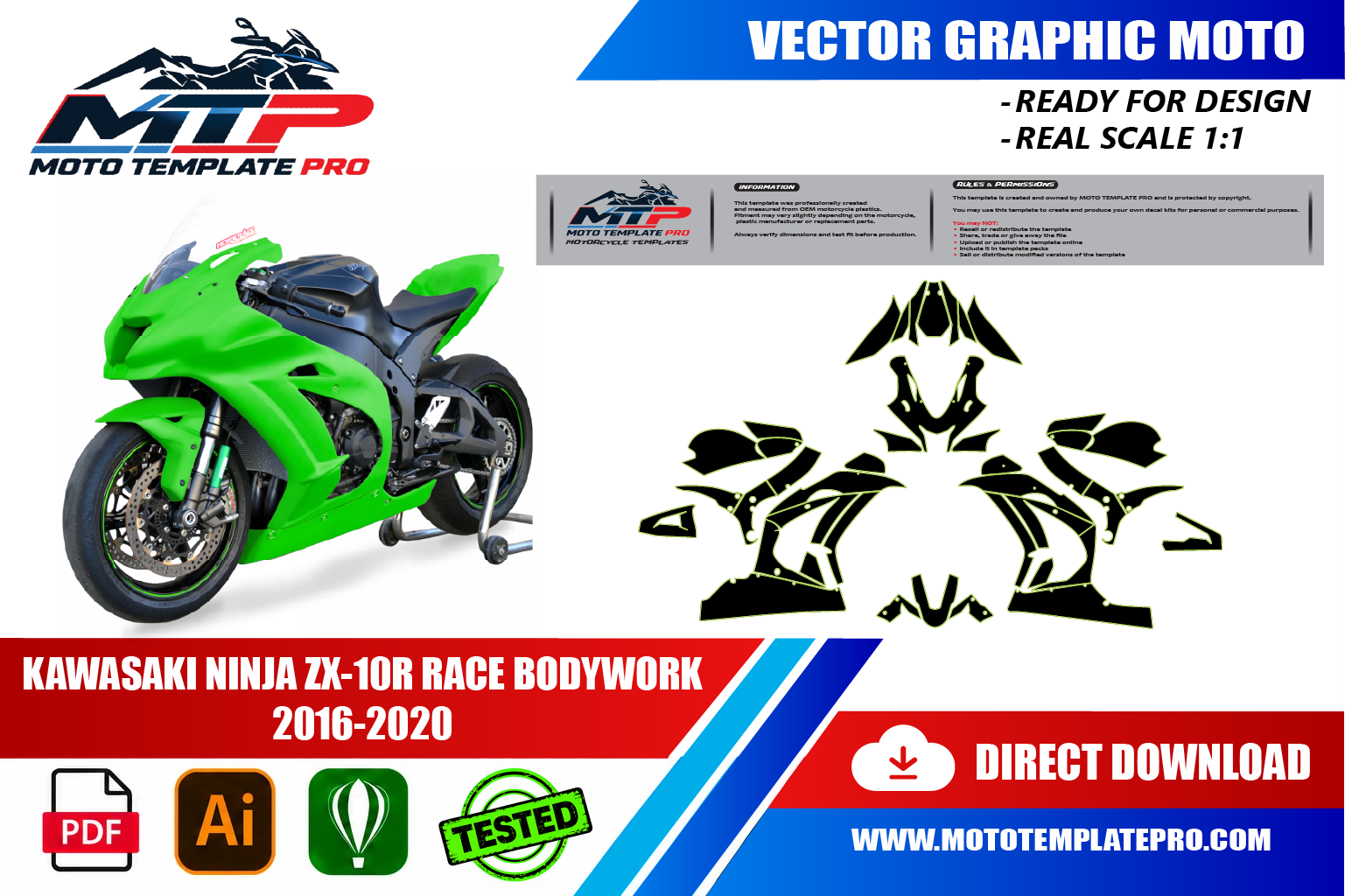
KAWASAKI NINJA ZX-10R RACE BODYWORK 2016-2020 Vector Template

KAWASAKI NINJA ZX-6R 636 2013-2018 ZX6R Vector Template
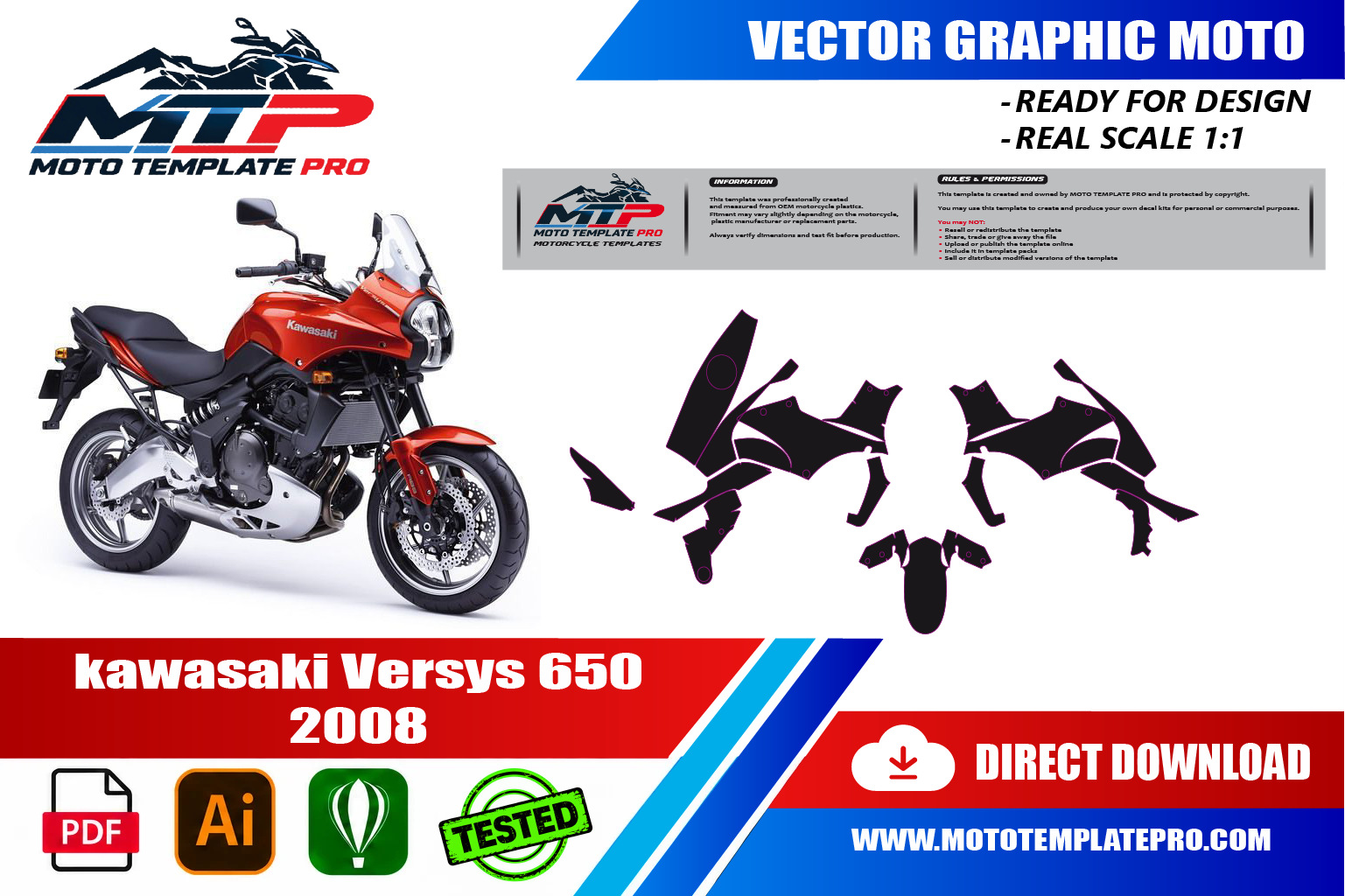
Kawasaki Versys 650 2008 Vector Template

Kawasaki Z900 2025-2026 Vector Template


Reviews
There are no reviews yet.