

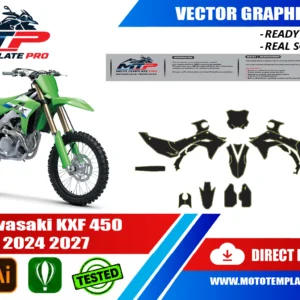


This Kawasaki KXF 450 2024-2027 vector template reproduces the Kawasaki KXF 450 2024-2027 at real scale (1:1) as an editable vector file.
Table of Contents
Kawasaki KXF 450 2024-2027 Vector Template: Overview
Use this Kawasaki KXF 450 2024-2027 vector template as an accurate base for decal kits, vinyl wraps, custom liveries and other graphics on the Kawasaki KXF 450 2024-2027. It is made for graphic designers, wrap installers and sticker manufacturers.
The Kawasaki KXF 450 2024-2027 template is a set of real-scale outlines for the modern full-size Kawasaki motocross bike, drawn so that a designer can start a livery from true shapes instead of guesswork. It suits anyone who wants a clean, current race look rather than a busy retro one.
Each file contains editable vector contours of the body panels at 1:1 scale, in AI, PDF and CorelDRAW formats, with layers grouped by part. It is a starting point for your own design, not a finished artwork ready to print. Designers, wrap installers and sticker makers use it as a precise drawing board, and it is an independent aid, not an official or approved file.
Modern 450 bodywork is slim, firm and full of small steps, so a hand-made template rarely survives the first test fit. Working from accurate outlines of the Kawasaki KXF 450 2024-2027 saves vinyl, time and patience before the first sheet goes through the cutter.
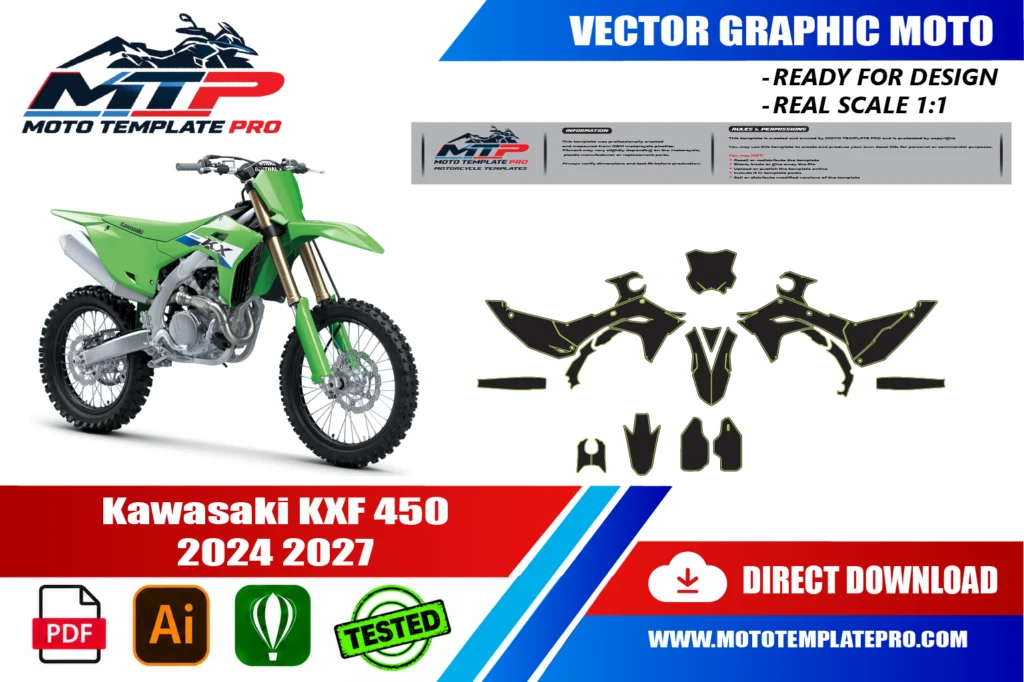
The template is provided as an editable vector file, compatible with Adobe Illustrator, PDF and CorelDRAW. It is a starting point for your own design work rather than a finished, ready-to-print graphic: a precise outline of the panels that you can use to position decals, plan a wrap layout or prepare a sticker kit at the correct scale. For background on why vector files are the standard for wrap and decal production, see the Adobe comparison of raster and vector formats.
How the Kawasaki KXF 450 2024-2027 grew from the 2024 redesign
The Kawasaki KXF 450 2024-2027 label spans several model years, so it helps to know what we could and could not confirm. Kawasaki sold the bike simply as the KX450 for the 2024 model year, when launch coverage described it as all-new: a lightweight aluminium perimeter frame, a revised engine layout with a centre-port exhaust head, new Brembo front brake parts and a smartphone app for changing engine maps. Reports also mention new, sleeker shrouds, side covers and rear fender, and a quick-release airbox cover that replaced a bolt which tended to strip.
Model years after the 2024 redesign
For 2025 we found no report of a bodywork change on the 450, but we did not verify it year by year, so treat 2025 as probably similar to 2024 and check your own bike. The 2026 update was described by one magazine as strictly cosmetic, with blue added to the radiator shroud graphics and no mechanical revisions. A first-look report on the 2027 bike, which regains the F in its name, describes revised bodywork that is slimmer, with a changed front fender, front number plate and shroud-to-tank mounting points, and says none of the 2024-2026 bodywork carries over. We read only that one report on 2027.
In short, the Kawasaki KXF 450 2024-2027 range may contain two different families of plastics. The year range in the name follows the template listing, so compare the outline with your real panels, especially if your bike is a 2027.
Body panels on the Kawasaki KXF 450 2024-2027, named one by one
Knowing the vocabulary makes a briefing much easier. On the Kawasaki KXF 450 2024-2027 the front fender is the slim mudguard above the wheel, and the front number plate sits ahead of the handlebar. The radiator shrouds, often called scoops, wrap the sides of the tank area and guide air towards the radiators.
The side covers, also called side panels or side number plates, close the flanks around the airbox, and the airbox cover is the removable part that gives access to the filter. The seat has a textured cover made for grip, so it should not receive a decal. At the back, the rear fender forms one long, narrow surface. Launch coverage described the redesigned panels as sleeker, which usually means smooth, uninterrupted areas that suit continuous graphics.
- Front number plate and front fender
- Radiator shrouds, left and right
- Side covers and airbox cover
- Rear fender
Our layers are grouped by part, so you can work on one panel at a time and then check the whole composition from nose to tail. Read the product description for the exact list of parts that are drawn.
Before opening the file, photograph each panel straight on with a ruler beside it. Comparing that photo with the outline shows quickly whether holes, cut-outs and mounting tabs sit where you expect them on your Kawasaki KXF 450 2024-2027.
Clean modern race graphics for the Kawasaki KXF 450 2024-2027
A current 450 looks best with restraint. The Kawasaki KXF 450 2024-2027 has smooth, slim panels, so a few confident shapes beat a crowd of small logos. Think in flows: one clean line that starts on the front fender, crosses the shroud and continues onto the side cover makes the bike look longer and lower.
Directions to try
- Pure team green: one main colour block on the shrouds, a white number plate zone and a single thin accent line.
- Two-tone split: a diagonal break between two colours across the side covers, with the rider name set small and sharp.
- Dark and stealthy: black and graphite with one bright accent, for riders who dislike loud graphics.
- Pit-board look: a plain white or grey base with large numerals and a short sponsor strip on the rear fender.
Modern graphics also depend on spacing. Keep consistent margins, align text to one baseline and limit yourself to two typefaces. Mind the seams: panels are separate parts with small gaps, so a continuous line should be designed with deliberate breaks, not perfect alignment.
Check your colours in daylight. Kawasaki lists the 2026 model in Lime Green, though we did not verify the colours of every year, so decide early whether your film covers the plastic fully or acts as an overlay that lets the base colour show.
From vector outline to cut file on the Kawasaki KXF 450 2024-2027
Start by hiding the layers you do not need. The outlines of the Kawasaki KXF 450 2024-2027 are grouped by part, so you can build one panel without disturbing another. Name every layer plainly, such as left shroud or rear fender, and lock it once the artwork is final.
Build the artwork larger than the contour, then trim it back. A bleed of about 3 to 5 mm gives the plotter or printer some room. Keep text and numbers inside a safe zone, away from edges, screws and cut-outs, and add registration marks when a panel is printed in sections.
For minimalist graphics, precision matters more than detail: a line that is 1 mm off will be seen on a plain panel. Snap shapes to a grid, use as few anchor points as you can and convert text to outlines before export.
Use the colour profile your print shop supplies, usually CMYK, and keep one spot colour for cut lines only. Export three files: a layered master, a cut-lines-only file for the plotter and a flattened proof for the client.
Before any vinyl is cut, measure a known distance on the artboard and compare it with the real part. Then print a paper test at actual size, tape it to the bike and look from several angles. Ten minutes of checking on the Kawasaki KXF 450 2024-2027 can save a whole kit.
Vinyl and laminate for a Kawasaki KXF 450 2024-2027 that gets washed hard
Race bikes are washed after every session, so pick materials accordingly. Cast vinyl is the safer choice for curved parts such as shrouds and the front fender, because it relaxes and conforms. Calendered film is stiffer and cheaper, and it suits flatter areas such as the side covers.
Protect the print with a clear overlaminate that resists UV. Satin hides fine scratches better than gloss, and very flat matt can look dull under dust. Let the printed ink degas before laminating, as your film maker advises.
Clean the plastic with isopropyl alcohol and avoid silicone products. Apply from the centre outwards with a squeegee, and use gentle heat only where the film must stretch around a radius. Too much heat dulls the finish or shrinks the film.
Wrap edges around the rim where the shape allows and give the adhesive a full day before the first wash. On a Kawasaki KXF 450 2024-2027 that is hosed down regularly, sealed edges are the best defence against lifting. Keep the pressure washer lance away from corners and seams.
Finally, keep spare film from the same print batch. After a crash, one reprinted shroud from the same roll matches better than a new batch printed months later.
Mistakes that spoil minimalist race graphics
Simple graphics hide nothing, so small errors show. The first mistake is designing on a flat screen without thinking about curves: a stripe that is perfect in a vector program can stretch where it crosses a deep radius on the Kawasaki KXF 450 2024-2027.
The second is ignoring screws, clips and openings. Keep text away from fasteners and vents. The third is placing important details too close to an edge, where they fold over or get scuffed by boots.
- Skipping the paper test at real size
- Printing without bleed, leaving thin white gaps
- Putting decals over the textured seat cover
- Using thin lines that vanish under dust
- Mixing panels from two model years without checking the fit
Another trap is mirroring by habit. Left and right sides are never perfect copies once logos and numbers are involved, so mirror deliberately and label every layer before export.
Finally, do not trust screenshots. A phone photo taken at an angle distorts proportions, and a design traced from it will not fit. Take dimensions from the real panel or from the 1:1 outline itself, and give the adhesive time before the first wash.
Choosing between 2024-2026 and 2027 shapes before you order the Kawasaki KXF 450 2024-2027
The Kawasaki KXF 450 2024-2027 is not necessarily one single set of parts. As explained above, one report on the 2027 bike says its bodywork is revised, including the front fender, the front number plate and the shroud mounting points, while the 2024 redesign had already brought new shrouds, side covers and rear fender. We did not verify differences between each model year, so check on the actual bike.
Check three points directly: the front fender and number plate, the radiator shrouds, and the rear section. Stand in front of the bike, then at the side, and take straight-on photos with a ruler beside each panel. Compare them with the product page.
Also ask whether your plastics are original. Replacement or aftermarket panels fitted after a crash can differ slightly in shape. Off-road KX450X versions exist as well, and we did not verify whether their plastics match. Compatibility can vary with exact variant, year and aftermarket parts, so compare the outline with the real panels before printing.
If you are unsure, photograph the parts and compare them with the listing before ordering. Kawasaki is a trademark of its owner. This template is an independent drawing aid, not an official, Kawasaki-approved or OEM file.
How This Template Is Built
This Kawasaki KXF 450 2024-2027 vector template is rebuilt as a fully editable vector outline from the real panel proportions of the Kawasaki KXF 450 2024-2027, rather than a rough tracing or a stretched photo. Working at true 1:1 scale means printers and installers can output panels straight from the file without rescaling, which keeps stripes, sponsor logos and pinstripes aligned exactly where they were designed.
Because the panel outlines are kept as separate, editable shapes, you can turn individual sections on or off while you design and export only the panels you actually need for production. On a vehicle of this kind (motocross or off-road bike), the typical panel groups include the front fender, radiator shrouds, side number plates, airbox cover and rear fender. Before printing, always measure a panel on the real vehicle against the file, since small production differences can happen and a quick check avoids a costly reprint.
What You Can Use This Template For
- Motocross decal and graphics kits
- Race team and sponsor graphics
- Number plate and rider name designs
- Full or partial vinyl wrap layouts
- Custom race liveries
This Kawasaki KXF 450 2024-2027 vector template suits race teams and riders preparing a new graphics kit, wrap shops quoting jobs sight-unseen, and sticker manufacturers who need a reliable base file instead of starting from photographs. Because the panel outlines are separated rather than merged into one flattened shape, you can isolate a single panel and export only what you need, which saves time when a project only touches part of the vehicle.

Files Included and How to Use Them
After purchase you get an instant digital download of the Kawasaki KXF 450 2024-2027 vector template in three formats. A typical workflow takes only a few steps:
- Download the file from your account or order email right after payment.
- Open the AI, PDF or CorelDRAW version in your vector software.
- Hide the panels you do not need and place your graphics, logos and colors on the rest.
- Print one test panel at 1:1 and check it against the real vehicle.
- Export the final artwork for your printer or cutter.
Printing, Scale and File Notes
Before you print this Kawasaki KXF 450 2024-2027 vector template, remember that it is built at real 1:1 scale, so the safest workflow is to print a single test panel first and lay it against the actual Kawasaki KXF 450 2024-2027 before committing to a full print run. A short test print is cheap insurance against a wasted roll of vinyl, especially around curved sections.
The vector layers are grouped by panel, which keeps the file manageable if you only need a subset of the panels, useful for a partial wrap, a single panel graphic or a small decal pack. If you run into a fitment question that is not covered here, reach out before you print. We would rather answer a quick question in advance than have you reprint a panel.

Also in our catalog: Kawasaki Ninja Z1000 SX 2020-2024 Vector Template, Kawasaki Versys 650 2008 Vector Template, Kawasaki Z650 2020-2022 Vector Template, Kawasaki Z900 2020-2024 Vector Template, Kawasaki Z900 2017-2019 Vector Template, Kawasaki Z1000 2014-2023 Vector Template.
Browse all Kawasaki vector templates.
Moto Template Pro is an independent design resource and is not affiliated with, endorsed by, or sponsored by Kawasaki or any manufacturer.
Which model years does this Kawasaki KXF 450 2024-2027 vector template cover?
This template is built specifically for the Kawasaki KXF 450 2024-2027.
Which panels carry the most graphics on a Kawasaki KXF 450 2024-2027?
The radiator shrouds and side covers carry most of the visible livery, with the front fender and rear fender close behind. The seat cover is textured for grip, so leave it plain. Plan your boldest shapes for the shrouds and side covers, and keep the number plate zone clear and high in contrast.
Will a Kawasaki KXF 450 2024-2027 template fit a 2027 bike?
We cannot promise it. One report says the 2027 bodywork is revised, including the front fender and front number plate, and the year range follows the template listing. Compare the outline with your real panels, or with clear photos taken beside a ruler, before printing anything. Compatibility can vary with exact variant and year.
How do I keep a Kawasaki KXF 450 2024-2027 design simple but professional?
Use two or three colours, one typeface family and consistent margins. Let one strong line flow from the front fender over the shroud to the side cover, and avoid tiny text that disappears under dust. Test the layout as a paper print at actual size on the bike before cutting vinyl.
Gloss or satin laminate for a Kawasaki KXF 450 2024-2027?
Satin is usually the safer choice: it hides fine scratches and washing marks better than gloss, and it still looks clean in photos. Gloss gives deeper colour but shows every scuff. Whichever you choose, use a UV-resistant overlaminate matched to your vinyl family and let the ink degas first.
How much bleed should I add for a Kawasaki KXF 450 2024-2027 kit?
A bleed of about 3 to 5 mm around each panel is a good rule. It gives the cutter or printer room and covers small positioning errors. Keep text, faces and numbers inside a safe zone away from the edge, screws and cut-outs, and wrap the edges around the rim where the shape allows.
Is this template compatible with other models?
No. Each model and generation has different bodywork, so this template is specific to this platform and differs from every other template in our catalog.
What file formats are included?
The template is provided in Adobe Illustrator, PDF and CorelDRAW, all as editable vector layers rather than a flattened image.
How is the file delivered?
As an instant digital download available immediately after purchase, with no physical items shipped and no waiting on a production schedule.
Is this an official Kawasaki product?
No. Moto Template Pro is an independent business, not affiliated with Kawasaki.
Kawasaki KLX 150 2013-2015 Vector Template
YAMAHA XT 660 R Vector Template
Yamaha YZ250FX 2024 2025 Vector Template

YAMAHA YZF 250 450 2006 2009 Vector Template


Reviews
There are no reviews yet.