

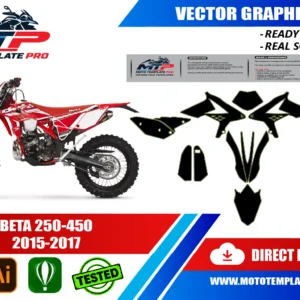


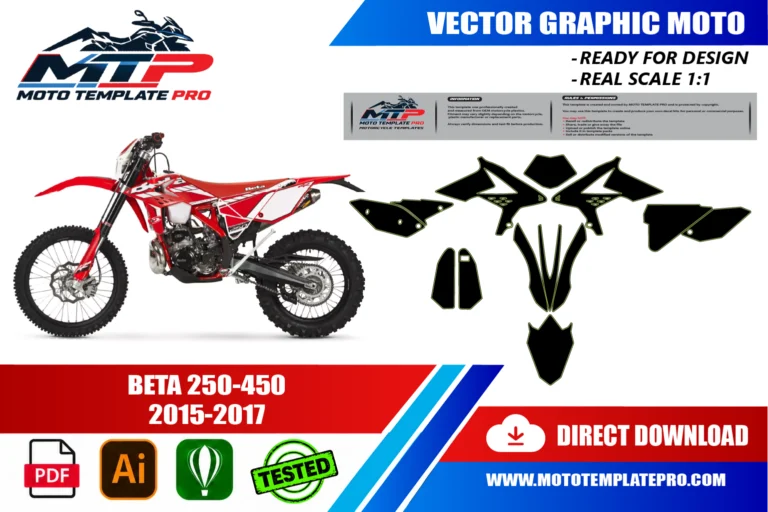
This Beta 250-450 2015-2017 vector template reproduces the Beta 250-450 2015-2017 at real scale (1:1) as an editable vector file.
Table of Contents
Beta 250-450 2015-2017 Vector Template: Overview
Use this Beta 250-450 2015-2017 vector template as an accurate base for decal kits, vinyl wraps, custom liveries and other graphics on the Beta 250-450 2015-2017. It is made for graphic designers, wrap installers and sticker manufacturers.
The Beta 250-450 2015-2017 template is a design base for the RR enduro range of the Italian maker across three model years, from the 250 two-stroke up to the largest four-strokes of the line. Our outlines follow the real body panels at full size, so designers, wrap installers and sticker makers can start from true shapes instead of guesswork.
Each file holds editable vector contours at 1:1 scale in AI, PDF and CorelDRAW formats, with layers grouped by part. It is a starting point for your own artwork, not a finished graphic, not a decal kit and not a physical item. We are an independent design resource and we have no affiliation with the manufacturer.
Bikes from this period are now used, restored and resold, which makes a vector base especially practical. Worn plastics, faded graphics and mixed replacement parts are common, so a Beta 250-450 2015-2017 project often begins with a refresh rather than a launch livery. Accurate outlines let you plan that refresh on screen before a single sheet of vinyl is cut.

The template is provided as an editable vector file, compatible with Adobe Illustrator, PDF and CorelDRAW. It is a starting point for your own design work rather than a finished, ready-to-print graphic: a precise outline of the panels that you can use to position decals, plan a wrap layout or prepare a sticker kit at the correct scale. For background on why vector files are the standard for wrap and decal production, see the Adobe comparison of raster and vector formats.
What the Beta 250-450 2015-2017 range actually covers
The name of this template is a convenient label, not an exact model list. According to the sources we checked, the RR enduro range in 2015 offered two-strokes at 250 and 300 and four-strokes at 350, 390, 430 and 480. Those four-stroke figures replaced earlier sizes of 400, 450 and 498, so a bike sold as a 450 before 2015 is not the same machine as the 430 that followed.
A first-look article describes the 2017 range as a direct evolution of the 2016 version, with the same two-stroke and four-stroke displacements. We did not verify the full 2016 list, and we did not verify whether smaller two-strokes such as a 125 were sold in every market during these years, so treat any list as indicative and not as a promise.
For a designer the lesson is simple: read the engine size and the registration year from the bike’s papers before you open the file, because model names and displacement labels vary by market. The Beta 250-450 2015-2017 range is a family with shared lines, not one frozen shape.
The maker also sold dual-sport RS versions, which at the 2015 launch shared the RR engine, frame and suspension in 390, 430 and 500 sizes. They carry road equipment, so lights and mirrors change what you can cover. We have not verified whether they share every panel with the RR, so check them separately.
What changed in 2015 on the Beta 250-450 2015-2017 line
The first year of the range was the year of a large mechanical revision. Reports say the four-stroke engines received lighter cases, a lighter crankshaft and flywheels, a shorter connecting rod, a new cylinder head and water jackets and a revised exhaust, with weight down by about 1 kg on the 430 and 480 and by up to 1.5 kg on the 350 and 390.
On fuel injection the sources differ. One says the RR 350 was the brand’s first fuel-injected off-road model, built with Synerject and a 42 mm throttle body, while another describes injection more widely across the four-strokes. Because of that disagreement we hedge on which engines had it in 2015 and which year each engine reached it.
The two-strokes were updated as well. The 300 reportedly took the engine of the 2014 Race Edition with a new cylinder, combustion chamber and CDI, and the 250 received a second exhaust valve spring and a new silencer. On the chassis side, the chrome-moly frame and aluminium swingarm were reported as unchanged, with a Sachs 48 mm fork and a piggyback shock revised internally and softer seat foam.
Graphics were new, in what the announcement called the classic colours of the brand. Why does this matter? Internal changes rarely alter the plastics, which suggests the silhouette stayed stable while the decoration was renewed. We did not verify whether the plastics were reshaped in 2015, so measure your own panels instead of trusting an old catalogue.
From 2016 to 2017 on the Beta 250-450 2015-2017 range: small steps, new graphics
The 2017 first-look article lists tweaks rather than overhauls: a Sachs fork 5 mm longer running Liqui Moly oil, a rear shock with independent high-speed and low-speed adjustment, lighter and stiffer triple clamps, silver Excel wheels with black spokes, a new fuel cap with a breather valve and a redesigned digital meter that adds a battery voltage reading.
The engines continued with automatic oil injection on the two-strokes, so no premixing, and electronic fuel injection on the four-strokes with a 42 mm throttle body, new cam profiles and revised valve springs. Euro4 compliance is mentioned for units built in the second half of that year. The Xtrainer 300 appears in the same article, but it is a different model and is not what this template covers.
For a graphics job, the visible news is a new graphics set for the range, and headlines we found mention Racing versions presented for 2017. We did not verify the exact 2016 graphics or any change to plastic colours, so do not assume that decals designed for 2016 and 2017 can be swapped without checking.
A practical method: photograph the radiator shrouds, side panels and tank area of your bike, note the year and compare the result with the outline. When a bike has mixed plastics, design for the part that is actually fitted, not for the year printed on the registration.
Body panels of the Beta 250-450 2015-2017, named part by part
A shared vocabulary avoids mistakes when you brief an installer. Catalogues differ between markets, so treat the list below as a glossary of the typical parts of an RR enduro and verify it against the bike in your workshop.
- Front fender and the headlight or number plate mask, depending on market
- Radiator shrouds, left and right, wrapping the tank area
- Fuel tank, which is plastic on most enduros and carries graphics
- Side panels and airbox cover, the removable flank pieces
- Rear fender and tail section with the light area
- Seat cover, a grip surface
The template provides these as separate layer groups, so you can hide the front end while you design the tail or export one panel as a paper test. Enduro panels are tall and narrow, with strong curves around the knee area, and that is where most distortion happens when a flat design is stretched across them.
Do not forget small items. Fork protectors, a skid plate and hand guards are fitted on many of these bikes, and they hide parts of the shrouds. Decide what stays visible before you draw, and keep logos away from areas that boots and branches will rub.
Livery ideas for the Beta 250-450 2015-2017, from refresh to race
Most machines of this age are working bikes, so a good livery is one that survives mud and still looks deliberate. Large blocks of colour and bold diagonals stay readable under dust far better than thin lines and tiny text. Aim for a clear idea on the shrouds and side panels and keep the seat area plain.
Directions to try
- Classic red: a red and black base with white keylines, close to the colours the brand has used for years.
- Clean refresh: the stock layout redrawn in sharper lines, useful when the original decals have faded or peeled.
- Team look: a restrained base with sponsor blocks on the side panels and a large number zone.
- Trail tourer: sand and olive tones with a thin accent line, for a bike that spends weekends on long routes.
Mind the seams. Panels are separate parts with small gaps, so a continuous stripe should be designed with deliberate breaks instead of a perfect match. Keep the number plate zone clear whichever direction you choose.
Test colours in daylight. Fluorescent and metallic films change outdoors, and a Beta 250-450 2015-2017 is photographed in forests and on dusty tracks, so judge your palette on a sample piece taped to the real panel before printing the whole kit.
Cut files, vinyl and fitting on a Beta 250-450 2015-2017
Open the file, rename the layers for your job and spell out left and right sides, because the two sides are rarely perfect mirror images once cut-outs and fasteners are counted. Extend artwork about 3 to 5 mm beyond each contour for bleed and keep text and logos away from edges, screws and vents. Print a paper copy at 100 percent, never fit to page, and tape it to the plastic.
Choose cast vinyl for deep curves such as shrouds and fork protectors, and calendered film for flatter areas such as side panels. Add a UV-resistant overlaminate that matches the film family and let the printed ink degas before laminating, as the film maker recommends.
Clean the plastic with isopropyl alcohol and avoid silicone products. Position each piece with tape hinges, squeegee from the centre outwards and use gentle heat only where the film must stretch. Too much heat shrinks the film or leaves it shiny. Wrap edges around the rim when the shape allows, and let the adhesive bond for a full day before the first wash.
The usual mistakes are skipping the paper test, printing without bleed, applying decals over the grip-textured seat and aiming a pressure washer at an open edge. On older bikes add one more: old adhesive residue under the new film, which shows through and lifts the edges later.
Choosing the right year and version before you buy for a Beta 250-450 2015-2017
Three model years, two engine types and several markets mean the Beta 250-450 2015-2017 is not one single shape. Before you buy any template, note which engine your bike has, which year the papers list and which plastics are fitted. Compare these with the product page, not with a photograph of someone else’s bike.
Check three points on the machine: the tank area and radiator shrouds, which carry most of the livery; the side panels and airbox cover; and the rear section, especially on versions with lighting. Replacement and aftermarket plastics are common on enduro bikes that have crashed, so the panels on a used machine may not match its stated year.
Compatibility can vary with the exact variant, year and parts fitted. We do not claim that every panel is identical across all engines and years, and we did not verify that. Measure first, order afterwards, and send us a photo with the model year if you hesitate.
Finally, think about how the bike is used. A competition machine that is stripped and rebuilt often needs a kit that is quick to replace, while a restored showpiece can justify a more elaborate multi-layer design. The outlines suit both, as long as the plan matches the way the bike is ridden.
How This Template Is Built
This Beta 250-450 2015-2017 vector template is rebuilt as a fully editable vector outline from the real panel proportions of the Beta 250-450 2015-2017, rather than a rough tracing or a stretched photo. Working at true 1:1 scale means printers and installers can output panels straight from the file without rescaling, which keeps stripes, sponsor logos and pinstripes aligned exactly where they were designed.
Because the panel outlines are kept as separate, editable shapes, you can turn individual sections on or off while you design and export only the panels you actually need for production. On a vehicle of this kind (motocross or off-road bike), the typical panel groups include the front fender, radiator shrouds, side number plates, airbox cover and rear fender. Before printing, always measure a panel on the real vehicle against the file, since small production differences can happen and a quick check avoids a costly reprint.
What You Can Use This Template For
- Motocross decal and graphics kits
- Race team and sponsor graphics
- Number plate and rider name designs
- Full or partial vinyl wrap layouts
- Custom race liveries
This Beta 250-450 2015-2017 vector template suits race teams and riders preparing a new graphics kit, wrap shops quoting jobs sight-unseen, and sticker manufacturers who need a reliable base file instead of starting from photographs. Because the panel outlines are separated rather than merged into one flattened shape, you can isolate a single panel and export only what you need, which saves time when a project only touches part of the vehicle.
Files Included and How to Use Them
After purchase you get an instant digital download of the Beta 250-450 2015-2017 vector template in three formats. A typical workflow takes only a few steps:
- Download the file from your account or order email right after payment.
- Open the AI, PDF or CorelDRAW version in your vector software.
- Hide the panels you do not need and place your graphics, logos and colors on the rest.
- Print one test panel at 1:1 and check it against the real vehicle.
- Export the final artwork for your printer or cutter.
Printing, Scale and File Notes
Before you print this Beta 250-450 2015-2017 vector template, remember that it is built at real 1:1 scale, so the safest workflow is to print a single test panel first and lay it against the actual Beta 250-450 2015-2017 before committing to a full print run. A short test print is cheap insurance against a wasted roll of vinyl, especially around curved sections.
The vector layers are grouped by panel, which keeps the file manageable if you only need a subset of the panels, useful for a partial wrap, a single panel graphic or a small decal pack. If you run into a fitment question that is not covered here, reach out before you print. We would rather answer a quick question in advance than have you reprint a panel.

Also in our catalog: Beta RX 450 2025 Vector Template, Beta Xtrainer 2023-2026 Vector Template, Beta RX 300 RR RR-S 2023-2024 Vector Template, Beta Enduro RR X-Pro 2025-2026 Vector Template.
Browse all Beta vector templates.
Moto Template Pro is an independent design resource and is not affiliated with, endorsed by, or sponsored by Beta or any manufacturer.
Which model years does this Beta 250-450 2015-2017 vector template cover?
This template is built specifically for the Beta 250-450 2015-2017.
Which engines does the Beta 250-450 2015-2017 cover?
The sources we checked list 250 and 300 two-strokes and 350, 390, 430 and 480 four-strokes for the RR range of these years. The 450 in the name is a rounded label, because the 450 size became 430 in 2015. Details vary by market and year.
Are the panels of the Beta 250-450 2015-2017 identical in every year?
We cannot promise it. Graphics changed between years, and we did not verify whether every plastic part is the same. Photograph your panels with a ruler and compare them with the product description before ordering.
Can I use the Beta 250-450 2015-2017 files to restore an older bike?
Yes, as a design base, as long as your plastics match the outline. Remove old adhesive residue first, check for aftermarket or replacement parts, and test a printed paper copy against the panel before you commit to vinyl.
Which vinyl suits a Beta 250-450 2015-2017 used in the woods?
Choose cast vinyl for the curves, add a UV-resistant overlaminate and seal every edge. Keep decals off the grip-textured seat, and let the adhesive cure for a full day before the first wash.
Where do most graphics go on a Beta 250-450 2015-2017?
On the radiator shrouds, side panels and front fender, with the tank area close behind. Plan big artwork there and use small accents on the rear fender. Keep the number plate zone clear, and check the rules of your event for sizes and colours.
Is this template compatible with other models?
No. Each model and generation has different bodywork, so this template is specific to this platform and differs from every other template in our catalog.
What file formats are included?
The template is provided in Adobe Illustrator, PDF and CorelDRAW, all as editable vector layers rather than a flattened image.
How is the file delivered?
As an instant digital download available immediately after purchase, with no physical items shipped and no waiting on a production schedule.
Is this an official Beta product?
No. Moto Template Pro is an independent business, not affiliated with Beta.

Beta Enduro RR X-Pro 2025-2026 Vector Template
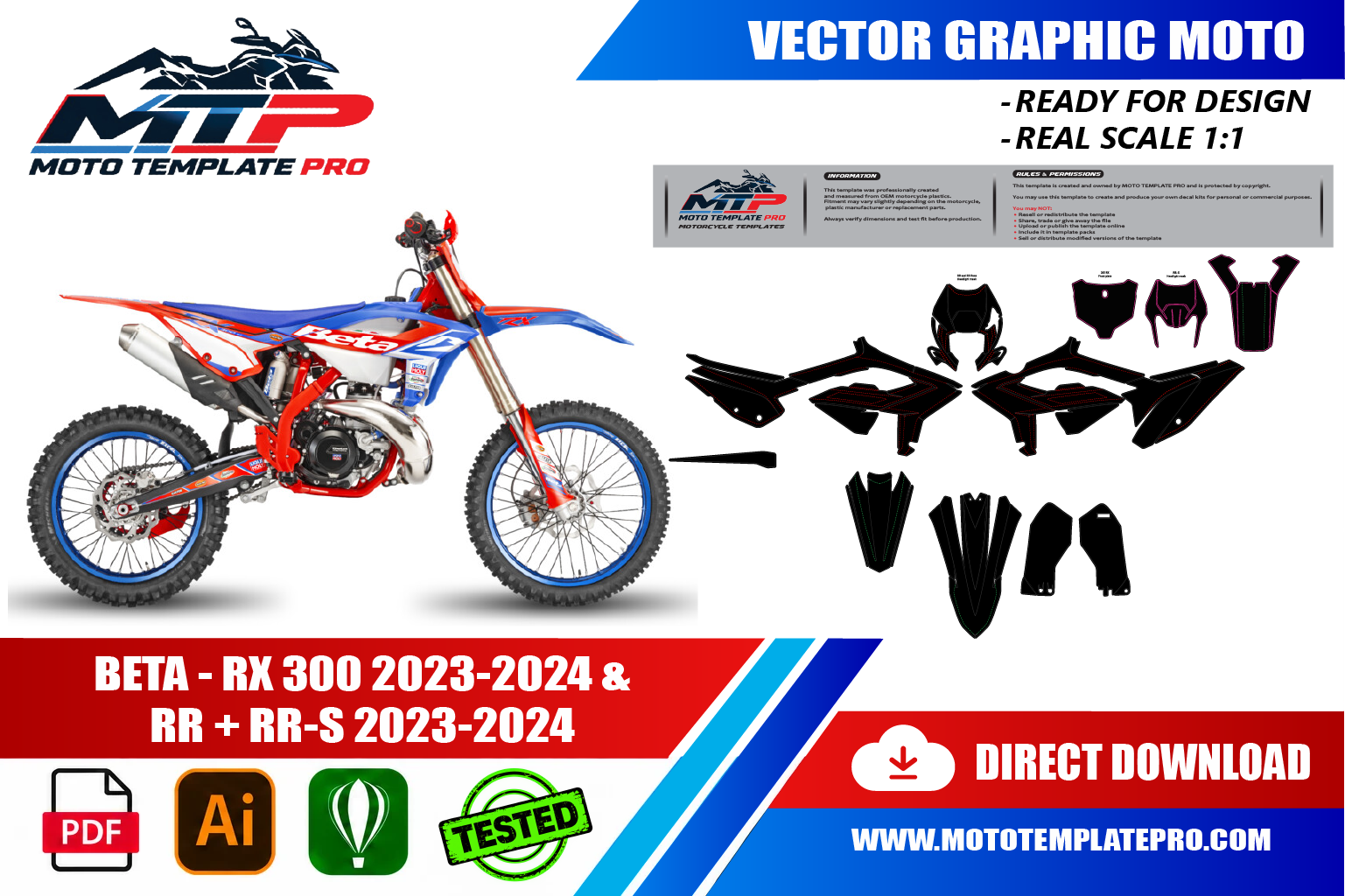
Beta RX 300 RR RR-S 2023-2024 Vector Template
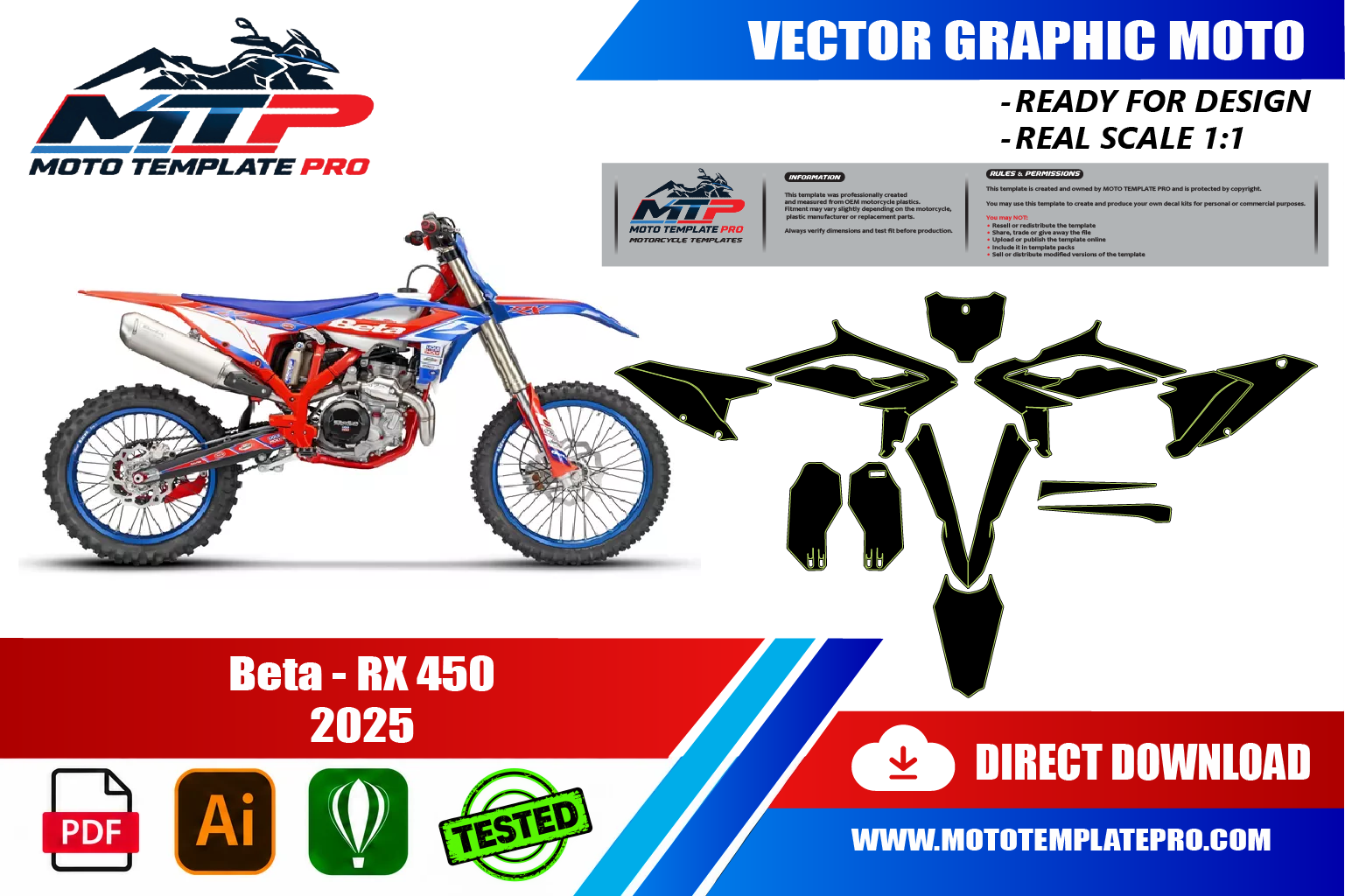
Beta RX 450 2025 Vector Template

Beta Xtrainer 2023-2026 Vector Template


Reviews
There are no reviews yet.